Wednesday, March 20, 2019

Anna Dorthea Johnson Kempe

Anna Dorthea Johnson prior to 1864,
Ready for America.
"Her heart thrilled with the gospel message and she could only say "I'll Go Where You Want Me To Go, Dear Lord".
Anna Dorthea Johnson Kempe 
born 5 February 1837 Fredrikstad, Norway; 
died 26 January 1901 Mesa, Arizona.
 Her story is one of courage, bravery and of an adventurous spirit, the stuff of legends, from Norway to America's wild wild west.

 Anna Dorthea Johnson (changed from Anne when she came to America) was born 5 February 1837 in Fredrikstad, Norway, the land of the Midnight Sun. Also the land of frozen rivers, high mountains, short summers and beautiful yet stern and hard land where an energetic people have produced a good life, not easy and it has made a strong and rugged people.
Her folks were fishermen and fished much at night when the fish would bite better. She learned to row a boat well when she was quite young. She learned to read, write, knit, sew and was raised a Lutheran, the religion most common then in the Scandinavian countries.
 At the age of 18, she apprenticed as a dressmaker and milliner at the Bertleson's home. It was there she first heard the Church of Jesus Christ of Latter Day Saints missionaries speak. She received a little book containing twenty-eight hymns, some of the Doctrine & Covenants and the Articles of Faith. As she was very serious and religious at heart, she read and re-read the book and was deeply impressed with the spirit and messages it contained. Anxiously she contacted the Church missionaries to attend their meetings and soon knew that they spoke the truth and wanted to join The Church. At the age of 21, Anna was baptized 24 April 1858. Her parents did not approve of her decision and even went as far as not allowing her back into their home. She felt she must go on and accept this gospel nevertheless, which she did, though her home and her folks were never the same to her after that. She left home and worked in various homes as a seamstress. After about about 10 years, she was able to emigrate to Utah, a desire she had cherished, though it was hard to leave her beloved country and loved ones even though they had cast her off. She saved enough money as she could to journey to Utah, but it wasn't enough, the main reason being that she contributed much of her earnings to the missionaries for their support. The mission president at that time, Brother O. H. Berg of Provo, UT testified that she was one of the best missionaries they had.  Short of funds, she arranged to care for a well to do lady on the trip and the lady would pay for her ticket. The old lady ended up being so disagreeable that Anna had to give up waiting on her. Anna was used to being on the water and did not get seasick on the trip. 
On April 1, 1864 she left Norway on a sleigh, bound for Denmark. Eventually she boarded the ship MONARCH OF THE SEA in Copenhagen, Denmark on April 28, 1864 bound for New York. (about the ship "The second company, totaling 974 Saints, sailed from Liverpool on 28 April 1864. Elder John Smith, patriarch to the church, was in charge of the emigrants. His counselors were Elders John D. Chase, Johan P. R. Johansen, and Parley P. Pratt, Jr. Master of the packet was Captain Robert Kirkaldy. This company also represented many nations, particularly Scandinavia. Although the voyage of thirty-six days was quite pleasant, the death toll was unusually high-forty-five according to George Q. Cannon and forty-one according to the passenger list. Most of those who died were apparently children. The ship arrived at New York on 3 June.")
Monarch of the Sea


Anna met a girl of the same age and with a similar name, Dorthea Mork (later to become Johnson). They quickly became friends and stayed together the entire journey all the way to Utah. During the voyage, there was considerable sickness and some deaths but landed safely June 3, 1864. 
Anna traveled from there to Salt Lake City Utah in the Isaac A. Canfield's Church Train arriving October 5, 1864; it must have been a wonderful relief to end the 5 month trip. They were met on the way by teamsters from Salt Lake City,and at once they began to learn the English language. Anna learned to speak it unusually well. Anna walked most of the way and most of the time barefoot to preserve her shoes, learning English along the way. 

After her arrival, Christopher Kempe, a former missionary that Anna had known in Norway came and asked for her hand in marriage. Christopher had by this time been married 3 months to Olena (Oline) Olsen. Anna accepted and would be his second wife and thus entered into polygamy on March 10, 1866. Polygamy was difficult to practice, but luckily both wives grew to become good friends and the children would grow up calling the other mother "Auntie". 
Soon after they were married, the Kempe family was asked to settle in Provo. Anna lived on their new farm on the Provo bench in a sod dugout house and Olena lived in town. Soon the children came and here Anna's first child was born,  Johanna C. F. (Hannah) was born February 3, 1867, next Betsy Amelia (Melia) Oct 19, 1868 and July 15, 1871 Amanda Christina (Manda) joined them. 
One story about the early Utah days is the lost calves, Anna had all the care of the cows and one winter the calves were gone, three or four of them. Snow was knee-deep. Anna dressed up warm and wrapped her feet in old clothes and went out in the fields going long distances hunting for the calves, all to no avail. The calves were lost. The family was left with heart ache and sorrow.
It seemed just as they were settling in, the family received another call to move this time to Richfield to help the settlement of the Saints. So in 1872, the family relocated to Richfield, Utah where only 50 other families lived at the time. Here the three younger daughters were born: Olena Dorthea (Thea) July 31, 1874, Emma on November 18, 1876 and Ruth Leila July 229, 1880. Kempe, as his wives called him, built two houses on Main Street and Second South: a two story house for Oline and behind that a smaller one for Anna and her daughters. They planted orchards of apples and peaches and gardens all of which thrived. Kempe said of the Richfield soil, "Where the red sandstone soil is, it exceeds anything else in fruitfulness, both for vegetables and grain." After 14 years in Richfield, the family was prosperous. 
Anna and four of her six children, taken about 1875-1876.
One can not tell from the black and white image, but Anna's hair is light red.
Christopher J. Kempe and family were called by President John Taylor to a "colonization mission" and were called to colonize northeastern Arizona. They left from Richfield, Utah on September 12, 1880, leaving behind their plush orchards and two comfortable homes. Their orchard had just produced fruit, but because the property was sold, they could not take any of the delicious fruit. The group may not have known that they were traveling to settle a place that was still barren and primitive. Even if they had, they wouldn't have been hesitant to answer a call from the prophet; such was their faith. This new life was the beginning of very real hardships, poverty and heartaches for a number of years.  
By September 21st, they were on the upper Kanab and Link valley, it was a large open country, beautiful with blue mountains. On the way to Arizona, the Kempe family crossed the Colorado River at Lees Ferry crossing on September 29th and camped on the east side of the river. Our Kempe family made it safely across and Anna even took her children out on the river for a boat ride. Because Anna had been raised so near the sea, she was delighted to see the water and on their boat ride, Anna did the rowing. Along the way, they did find two or three little cabins. To get to water and grass for the cattle were always the main problems in choosing a camp site. On the trip, Anna had her very young baby, Leila just a few weeks old. How difficult that must have been! October 16, 1880, they arrived at their destination, Saint Johns - not named then- was just a very small crossing on the Little Colorado River, crudely made to allow trappers, scouts and sheep men to cross, sometimes with a small band of sheep on the road to Fort Apache. A few brush and adobe mud sheds had been put up for shelter. When Christopher Jensen Kempe and his family arrived, some Church colonists had arrived previously and were getting located, but there was not any house for the Kempe family. Winter was fast approaching and they were sick and tired of camping. They fixed a camp with brush, sticks and sod and with their wagon boxes, set down on the ground, they lived with that for a time. Olena, the other wife, had two small rooms and these housed the first Church of Jesus Christ of Latter Day Saints Sunday school and day school in St Johns, Arizona. 
First home in Saint Johns, AZ, 1880


Needless to say, the first winter was a pretty hard one. Very little food could be obtained and had only a little wheat to ration out; the wheat was ground each day with a little handmill. Here her husband made one trip into Albuquerque, New Mexico for supplies and returned with some white flour and other things. Anna made some biscuits with it, the children came in from playing by the river looked at them and thought that they were some kind of cake. This was a thrilling sight for the children, as they were used to ground wheat flour.
Sunday school was being held one morning while Anna was bathing her young baby, Leila, when the cry of "Fire, Fire," was heard. All the Sunday School rushed out, grabbed  buckets or anything that would hold water, then ran to the nearby river and soon had the fire extinguished, but not before it had burned a stack of brush and weeds that was to feed the milk cows during the winter. Some squash or pumpkins were stored in the stack and these were ruined. Anna's daughter, Amelia, who told this story, remembered it because her mother cried at the loss and it was very seldom that she cried.

Anna scraped under the edges of the wheatstack for loose wheat that had been pressed out when the loads that were heavy threshed the kernels out. (The waste wheat in other words). Anna would wash it, dry it and sift it with the wind and then grind it on a little coffee mill that had been nailed to the wall. Anna's children did much of the grinding for both of Christopher's families to get meal for the bread. The girls report that the grinding took nearly all day. Auntie (Oline, the first wife) lived in town so her family did not have to do any of the grinding.

Years of privations made for vigorous schooling and even with hardships innumerable, their faith never faltered and their struggles mellowed them and made them stronger. It was a hard life in St. Johns, but they worked hard and prospered.

In December 1881 (other accounts say it was about 1890),  Anna made a decision about the outlawing of polygamy and living that way. She decided, "I am going to obey the law. I will not live with Kempe any longer and break the law." She kept her word. Christopher was welcome in her home and would occasionally eat meals, but could not sleep there anymore. The polygamy situation was difficult for the entire Kempe family. Christopher often had a hard time providing for the family's needs. Also, even though Christopher treated Anna with respect, she was the "second" wife. Oline usually had the bigger house wherever they lived and probably had Christopher's company in Oline's home more. Maybe for these reasons, the family didn't speak highly of polygamy in general.

Of course Anna always had a garden and an orchard whenever possible. During the growing season it was a daily task for her to work in the garden. There were weeds to be kept down, ditches for irrigating had to be made and other tasks. She did not have any sons to share these labors. The fresh vegetables were such and addition to their food supply and so welcome that she did not mind the labor involved.

Anna kept in touch and was friendly with her parents in Norway by correspondence. They never joined The Church. Upon the local settlement of her parents property, $100 was sent to her as her share. It came when she needed it so much. With $80.00 of it she purchased a sewing machine and the first night that they had it she and her daughters sat up most of the night trying it out, making a dress. For $10.00 she bought a baby bed and of course $10 went for tithing.
A tragedy struck Anna's family when in 1889, thirteen year old Emma was thrown from a horse and killed. She is buried in St Johns.
Anna with her five girls, St Johns, AZ about 1886.
Back fow: Amanda, Amelia Olena
Front row: Anna, Leila an Hannah
(Emma died before this picture was taken)

Initially, Anna lived on what they called the "Farm" which was a rock-house outside of St Johns across the Little Colorado River and then quite a walk south. Anna and her girls lived there about 3-4 years then the church-built rooms (these rooms were built by church members during the time Christopher Jensen Kempe was incarcerated in the Detroit prison for polygamy) until they moved into town. Anna felt she must support herself so she bought and kept her own home in St. Johns near the town square and The Church house.  This little home of Anna's had three rooms and a porch which they made into a bedroom and later Anna built a kitchen and another room onto it. Anna received $150 from the sale of the "Farm" as it was called and she borrowed some money from Charles P Anderson and some from her married daughter Johanna Greer to help her make the payments. When Anna asked Charles P Anderson if he needed security for the loan, he replied, "No, Sister Kempe, your word is as good as your bond." 
As soon as Anna could, she planted an orchard and different berry bushes, using every inch of space that she had. The first fruit for winter was put in cans with a tin lid soldered on with some kind of rosin. They dried fruit for winter and found that quite satisfactory, and when they had glass bottles that seemed just perfect. Fruit was a luxury there in those days. Only on rare and very special occasions were bananas and oranges brought in from the railroad, about sixty miles away. 
Anna planted quite a few trees on her lot. She filled up her lot with choice trees, 4 or 5 currant bushed, goose-berried and flower in every spot available. The flowers were lilac bushes on either side of entrance path, roses and hollyhock, pinks and other. She also had delicious peach trees. Her daughter, Amelia reflects, "I remember how the Mexicans came to buy those early peaches and would not wait for them to get ripe and they came for cantaloupes and watermelons, even if they were a little green, they wanted them. Mother sold milk and fruit and garden stuff to help make our living."
Anna D. Johnson Kempe


Anna always had a cow or two to provide them with milk and butter and she usually always had a calf to fatten for beef. She would have felt lost without a cow to milk each morning and evening. On her little plot of land, she kept a good barn (was still standing in 1952) where she kept they hay for her cows. She kept some chickens and usually a pig to help provide a living. Skunks were prevalent and they killed and bothered her chickens. To keep the skunks out, Anna made homemade box traps. Her daughters knew that she killed them, but they never knew how she did it.
Anna was a good cook and always had yeast on hand. The story goes, "Anna did not make her yeast for monetary value, rather, she enjoyed the service because it helped others. There were many people coming with their two cups of flour in a little bucket or pitcher to trade her for her good foamy yeast. She always had a pot of yeast brewing.
Anna was an accomplished seamstress and earned extra money sewing the beautifully colored silks and satin for the wealthy Mexican women in the area. Eventually, she had four or five sewing machines. She even sewed a new robe for the Father of the Catholic church in town. The story goes the Padre needed a new robe and knew that Anna did sewing. Anna was used to making nice silk dresses for the ladies and suits for the men, so she was not afraid to undertake this for "the Father". But she had not counted on it being so heavy and cumbersome. The Father was a tall man and the robe was to be made of heavy cloth, full length down to the floor, long sleeves, high neck and lined throughout and of course, black. It was warm weather; perspiration poured down her face and her hands were moist as she worked on it. It was very heavy to lift and she labored as she finished it. The Father was pleased with it and Anna's masterful sewing saved him a trip to Albuquerque to get a new one made.
Speaking of the Mexicans, they would come to Anna and say, "Come, come,  "Colorow" (from Anna's light red hair) my child is sick you fix him." How they came to her in their troubles and pleasures as well as to make their dresses.
Anna holding a grandchild, seated with her daughters, sewing on the porch.
While visiting her daughter, Thea,  for the winter in Mesa at 69 years old Anna became sick with influenza and after a short illness died, January 26, 1907.

Anna D. Johnson Kempe (1837-1907)
Anna is buried in the Mesa City Cemetery on Center Street in Mesa Arizona. What a beautiful legacy she left behind. Thank you my dear great great grandmother Anna for a life well lived.
Anna's gravestone located in Mesa City Cemetery
Anna's obituary, Deseret Evening News, 19 Feb 1907, Tue, Page 3

Anna's children say of her, "When I think back on Mother's life, her teachings, maxims and choice quotations she used, I feel that she was one of God's most noblest children. She had not great advantages for education, yet she possessed knowledge that far surpassed many of the learned. If we resented the treatments she or we had received, she would say, "It is better to suffer wrong than to do wrong" and " Never do a wrong, thinking no one sees you, for you always see yourself, and how can you respect yourself if you know you are not honest with yourself" also " If a thing is worth doing, it is worth doing well." 
Her daughters said of Anna, " It seemed she possessed all the desired virtues." 

Sunday, December 31, 2017

My Abraham Livingston connection and the War for Independence


It is so important to know where we come from, the forces, events and ideas that helped shape our worlds and the people we come from. This notion has been a strong theme in my life, I feel compelled and almost responsible to know my people and their stories. I have big feelings about my people and love them for the things they did and the sacrifices they made. "My people" made me and I promise I will not forget.

On to today's story, I want to share the stories about the Livingston family. This story centers around the war for Independence and my ancestor Captain Abraham Livingston. Abraham  was born about October 1753  in New York, United States and we have record of his christening 03 October 1753 in the Reformed Dutch Church, New York, New York. He was born to the wealthy and affluent father who was a merchant and trader, John Livingston and Catarina Ten Brock, the daughter of Col Dirck Ten Broeck and Margarita Cuyler. Catarina must have had very high opinions (and gives us a peak into her character) as it is said of his mother, Catarina,
" ...she never spoke the English language. A description of the ceremonious visits the children of the family paid their grandmother is still repeated among the descendants. On New Year's, the only day of the year on which the grandchildren were permitted to visit her apartments, they came with the greatest delight, mingled with awe. The low curtsy was made, and their greetings spoken in Dutch taught them for the occasion."
Catryna Ten Broeck Livingston, portrait of her childhood
By 1765, Abraham was about 12 years old and the family had moved to Montreal Canada most certainly for his father John Livingston to pursue his business of trader and merchant. Having been raised by a strict Dutch mother, he had to have been fluent in the Dutch language, and being American knew English, but the family also lived in French Canada for a number of years, so it is probable that Abraham was knowledgeable in the French language as well. So a linguist? Probably. We also know that Abraham was employed as a clerk for Mr Oakes of Ermintinoex in the Indian territory as a fur trader just prior to the outbreak of the war.

Abraham was about 22 years old when his older brother, Col James Livingston, raised a regiment named the 1st Canadian Regiment in September 1775 to fight for the cause of freedom for a fledgling nation. Abraham was named a captain in his brother's regiment and fought alongside his 2 older brothers, Lt Col Richard Livingston and Col James Livingston in the Battle Of Quebec in 1775. This war was fought on December 31, 1775, between American Continental Army forces and the British defenders of Quebec City early in the American Revolutionary War. The battle was the first major defeat of the war for the Americans, and it came with heavy losses. General Richard Montgomery was killed, Benedict Arnold was wounded, and Daniel Morgan and more than 400 men were taken prisoner. The city's garrison, a motley assortment of regular troops and militia led by Quebec's provincial governor, General Guy Carleton, suffered a small number of casualties.
American forces are shattered in fierce street fighting during the Battle of Quebec.

What a tragic engagement for Abraham to have been involved in to begin his military service in the war for Independence.
It must have been especially difficult as Abraham, Richard and James were all related to the fallen General Richard Montgomery through the marriage of Richard to the brother's cousin, Janet Livingston.
What did George Washington say of Richard Montgomery's passing?
Phillip Schuyler and General George Washington were devastated upon hearing of Montgomery's death. Schuyler believed that without Montgomery, victory in Canada was not possible. He wrote to Congress and Washington that "My amiable friend, the gallant Montgomery, is no more; the brave Arnold is wounded; and we have met a severe check, in an unsuccessful attempt on Quebec, May Heaven be graciously pleased that the misfortune may terminate here."Washington wrote to Schuyler, "In the death of this gentleman, America has sustained a heavy loss, as he had approved himself a steady friend to her rights and of ability to render her the most essential services." Congress reacted to Montgomery's death by trying to keep the loss as quiet as possible. They feared the news would lower the morale of the troops and civilians.
We next see the Livingston brothers in both The Battles of Saratoga (September 19 and October 7, 1777) which marked the climax of the Saratoga campaign, giving a decisive victory to the Americans over the British in the American Revolutionary War. It was a major turning point for the American cause.
British General John Burgoyne led a large invasion army southward from Canada in the Champlain Valley, hoping to meet a similar British force marching northward from New York City and another British force marching eastward from Lake Ontario; the southern and western forces never arrived, and Burgoyne was surrounded by American forces in upstate New York. He fought two small battles to break out which took place 18 days apart on the same ground, 9 miles (14 km) south of Saratoga, New York. They both failed. He later served as Captain in the New York Levies.(only found one reference to this, needs more research)

I read that Abraham was involved in The Battle of Monmouth which was an American Revolutionary War battle fought on June 28, 1778, in Monmouth County, New Jersey. I will need to do further research to see what regiment he fought in, I found evidence that he served in the New York Levies as a captain and maybe that was his involvement. The Continental Army under General George Washington attacked the rear of the British Army column commanded by Lieutenant General Sir Henry Clinton as they left Monmouth Court House (modern Freehold Borough). It is also known as the Battle of Monmouth Courthouse.

Next we see Abraham at The Battle of Rhode Island (also known as the Battle of Quaker Hill and the Battle of Newport) took place on August 29, 1778. Continental Army and militia forces under the command of General John Sullivan were withdrawing to the northern part of Aquidneck Island after abandoning their siege of Newport, Rhode Island when the British forces in Newport sortied, supported by recently arrived Royal Navy ships, and attacked the retreating Americans. The battle ended inconclusively, but afterwards Continental forces withdrew to the mainland, leaving Aquidneck Island in British hands.

The battle was the first attempt at cooperation between French and American forces following France's entry into the war as an American ally. Operations against Newport were planned in conjunction with a French fleet and troops, but they were frustrated in part by difficult relations between the commanders, as well as by a storm that damaged both French and British fleets shortly before joint operations were to begin.
Abraham Livingston served in the army until right about the time the war ended 1781 for about 6  years. He must have witnessed horrible things and done things he might not have wanted to do that always accompany war, and for him to be involved in so many battles without serious injury or death also speaks to Abraham's strength and character.
I never see note or documentation from the government any compensation for Abraham's service, I do see Abraham's heirs petitioning for back pay. I'm not sure what the outcome of this action was. This is not to say he was never compensated, I just can not find evidence of it. I do however know that Abraham's brother, Col James Livingston , was given thousands of acres of land for his service to the cause.
additional documentation from Jane Vanderhayden of Abraham's involvement in the war date 2 March 1799


document showing Captain Abraham Livingston allegiance, service and actions in the Revolutionary war
dated February 1799.

After Abraham's service in the war, he married 13 Feb 1782 in Rensselear, New York to Mara Bradt Peebles, the daughter of Thomas Peebles and Elizabeth Bradt. After the war he removed and settled at Stillwater, near the siege of Fort Erie. Abraham and Maria would go on to have 8 children, 6 daughters and 2 sons. Of the 2 sons, Thomas died young from drowning and John Peebles married but did not have any children. We see then that the Livingston name, for this line, going forward dies with his sons and daughters. Abraham and Maria had the following children:

1) Elizabeth Livingston Hubbard (1782-1807)
2) Angelica Livingston (abt 1785-____) died young
3) Catharine Livingston Mather (1787-1855)
4) Rosanna Livingston Schuyler (1790-1857)
5) John Peebles Livingston (1792-1852)
6) Maria Livingston O'Donnell (1795-1867)
7) Jane Livingston Williams (1797-1844)
8) Thomas Livingston (1800-1809) drowned at the age of 9

 Abraham died relatively young at the age of 49 on  03 July 1802, New York, United States and his grave stone is located in the Stillwater Union Cemetery, in Stillwater, Saratoga, New York. He left a large family with the youngest only 2 years old at his passing.

.Although the Livingston name disappears going forward from my family tree with this great man, I still feel the Livingston blood in me and feel pride for the part they played in gaining our Nation's freedom.

Thank you Abraham for what you did for our country and for our family.

Thursday, December 28, 2017

Mary Dyer, Social Reformer, Quaker Prophetess and Religious Martyr, my ancestor


I am a 12th great grand daughter of Mary Dyer, the Quaker prophetess, preacher and martyr.

Convinced that the intolerant law of Massachusetts Colony banishing Quakers violated God’s law, Mary Dyer would not stay quiet or stay away. Mary was a Quaker, and Quakers believed that God could communicate directly to us and that salvation could be assured. This was considered heresy by the Puritans in Massachusetts, so they banished her from the colony. She was brought before the Court of Magistrates, which sentenced her to death and publicly hanged on June 1, 1660.

Mary Dyer (born Marie Barrett; c. 1611 – 1 June 1660) was an English and colonial American Puritan turned Quaker who was hanged in Boston, Massachusetts Bay Colony, for repeatedly defying a Puritan law banning Quakers from the colony. She is one of the four executed Quakers known as the Boston martyrs.
While the place of her birth is not known, she was married in London in 1633 to the milliner William Dyer. Mary and William were Puritans who were interested in reforming the Anglican Church from within, without separating from it. As the English king increased pressure on the Puritans, they left England by the thousands to go to New England in the early 1630s. Mary and William arrived in Boston by 1635, joining the Boston Church in December of that year. Like most members of Boston's church, they soon became involved in the Antinomian Controversy, a theological crisis lasting from 1636 to 1638. Mary and William were strong advocates of Anne Hutchinson and John Wheelwright in the controversy, and as a result Mary's husband was disenfranchised and disarmed for supporting these "heretics" and also for harboring his own heretical views. Subsequently, they left Massachusetts with many others to establish a new colony on Aquidneck Island (later Rhode Island) in Narraganset Bay.

Before leaving Boston, Mary had given birth to a severely deformed infant that was stillborn. Because of the theological implications of such a birth, the baby was buried secretly. When the Massachusetts authorities learned of this birth, the ordeal became public, and in the minds of the colony's ministers and magistrates, the monstrous birth was clearly a result of Mary's "monstrous" religious opinions. More than a decade later, in late 1651, Mary Dyer boarded a ship for England, and stayed there for over five years, becoming an avid follower of the Quaker religion that had been established by George Fox several years earlier. Because Quakers were considered among the most heinous of heretics by the Puritans, Massachusetts enacted several laws against them. When Dyer returned to Boston from England, she was immediately imprisoned, and then banished. Defying her order of banishment, she was again banished, this time upon pain of death. Deciding that she would die as a martyr if the anti-Quaker laws were not repealed, Dyer once again returned to Boston and was sent to the gallows in 1659, having the rope around her neck when a reprieve was announced. Not accepting the reprieve, she again returned to Boston the following year, and was then hanged to become the third of four Quaker martyrs.

Dyer returned to Boston on 21 May 1660 and ten days later she was once again brought before the governor. The exchange of words between Dyer and Governor Endicott was recorded as follows:

Endicott: Are you the same Mary Dyer that was here before?

Dyer: I am the same Mary Dyer that was here the last General Court.

Endicott: You will own yourself a Quaker, will you not?

Dyer: I own myself to be reproachfully so called.

Endicott: Sentence was passed upon you the last General Court; and now likewise--You must return to the prison, and there remain till to-morrow at nine o'clock; then thence you must go to the gallows and there be hanged till you are dead.

Dyer: This is no more than what thou saidst before.
Endicott: But now it is to be executed. Therefore prepare yourself to-morrow at nine o'clock.
Dyer: I came in obedience to the will of God the last General Court, desiring you to repeal your unrighteous laws of banishment on pain of death; and that same is my work now, and earnest request, although I told you that if you refused to repeal them, the Lord would send others of his servants to witness against them.

Following this exchange, the governor asked if she was a prophetess, and she answered that she spoke the words that the Lord spoke to her. When she began to speak again, the governor called, "Away with her! Away with her!" She was returned to jail. Though her husband had written a letter to Endicott requesting his wife's freedom, another reprieve was not granted.

On 1 June 1660, at nine in the morning, Mary Dyer once again departed the jail and was escorted to the gallows. Once she was on the ladder under the elm tree she was given the opportunity to save her life. Her response was, "Nay, I cannot; for in obedience to the will of the Lord God I came, and in his will I abide faithful to the death." The military commander, Captain John Webb, recited the charges against her and said she "was guilty of her own blood." Dyer's response was:
Nay, I came to keep bloodguiltiness from you, desiring you to repeal the unrighteous and unjust law of banishment upon pain of death, made against the innocent servants of the Lord, therefore my blood will be required at your hands who willfully do it; but for those that do is in the simplicity of their hearts, I do desire the Lord to forgive them. I came to do the will of my Father, and in obedience to his will I stand even to the death.

— Dyer's words as she prepared to hang
Her former pastor, John Wilson, urged her to repent and to not be "so deluded and carried away by the deceit of the devil." To this she answered, "Nay, man, I am not now to repent." Asked if she would have the elders pray for her, she replied, "I know never an Elder here." Another short exchange followed, and then, in the words of her biographer, Horatio Rogers, "she was swung off, and the crown of martyrdom descended upon her head.


My Mayflower connection to 9 passengers


Mayflower

So exciting to learn I am connected to 9 original Mayflower passengers. On my father's side, I have direct ancestry to John Tilley and his wife Joan Hurst, their daughter Elizabeth Tilley and her husband John Howland and also to Degory Priest. On my mother's side directly come from Isaac Allerton and his wife Mary Norris and to their daughter Mary Allerton the wife of Thomas Cushman (Thomas Cushman was not a Mayflower passenger, he came to America in 1621 on the ship Fortune) and to Richard Warren (his wife Elizabeth Walker and their daughter Elizabeth Warren later came on the Anne in 1623-the wife of Richard Church).
On September 6, 1620 the Mayflower departed from Plymouth, England, and headed for America. By the time the Pilgrims had left England, they had already been living onboard the ships for nearly a month and a half. The voyage itself across the Atlantic Ocean took 66 days, from their departure on September 6, until Cape Cod was sighted on 9 November 1620. The first half of the voyage went fairly smoothly, the only major problem was sea-sickness. But by October, they began encountering a number of Atlantic storms that made the voyage treacherous. Several times, the wind was so strong they had to just drift where the weather took them, it was not safe to use the ship's sails. The Pilgrims intended to land in Northern Virginia, which at the time included the region as far north as the Hudson River in the modern State of New York. The Hudson River, in fact, was their originally intended destination. They had received good reports on this region while in the Netherlands. All things considered, the Mayflower was almost right on target, missing the Hudson River by just a few degrees.
As the Mayflower approached land, the crew spotted Cape Cod just as the sun rose on November 9. The Pilgrims decided to head south, to the mouth of the Hudson River in New York, where they intended to make their plantation. However, as the Mayflower headed south, it encountered some very rough seas, and nearly shipwrecked. The Pilgrims then decided, rather than risk another attempt to go south, they would just stay and explore Cape Cod. They turned back north, rounded the tip, and anchored in what is now Provincetown Harbor. The Pilgrims would spend the next month and a half exploring Cape Cod, trying to decide where they would build their plantation. On December 25, 1620, they had finally decided upon Plymouth, and began construction of their first buildings.


(My connection to Isaac Allerton, Mary Norris and Mary Allerton: Sarah Cushman, Ebenezer Hawkes Sr, Ebenezer Hawkes Jr, Benjamin Hawkes, Joshua Hawkes, Joseph Bryant Hawkes, Amos Hawks, Joshua White Hawks, Illa L C Hawks, Carroll Denon Williams..)

1) ISAAC ALLERTON

Isaac Allerton: Isaac Allerton may have come from the vicinity of Ipswich, co. Suffolk, England. He first appears in Leiden, Holland records on 4 November 1611, when he married Mary Norris. Isaac had a sister named Sarah who also resided in Leiden, and who married future Mayflower passenger Degory Priest. He was probably also related, perhaps a brother, to Mayflower passenger John Allerton.
Isaac Allerton is one of the most complex figures in early Plymouth Colony. He was elected assistant to Governor Bradford in 1621, and continued in that capacity well into the 1630s. He was the individual sent to handle most of the buyout negotiations with the London investors that commenced in 1627, and continued through the early 1630s. Allerton soon began to take advantage of his position by engaging in some personal trading deals, and engaging the Pilgrims' joint-stock company in business ventures they had not authorized. After driving the colony deeper into debt with ill-advised business opportunities, he was eventually removed and replaced by Edward Winslow. After the death of his wife Fear in 1634, he retreated to the New Haven Colony and married there to Joanna Swinnerton. Allerton became an active merchant trader, engaging in transactions and trade with many neighboring colonies including the Dutch at New Netherlands; New Sweden; Virginia; Massachusetts Bay; and Barbados.


2) MARY NORRIS ALLERTON

Mary Norris: Mary (Norris) Allerton was about thirty when she came on the Mayflower with her husband Isaac and three children Bartholomew, Remember, and Mary. Her marriage record in Leiden indicates she was from Newbury, which is presumably Newbury, co. Berks, England. Searches of this area for her baptism record and other Norris family records have not yet turned up anything conclusive. They buried a child at St. Peters, Leiden, on 5 February 1620, and she gave birth to a stillborn son in Plymouth Harbor on 22 December 1620. She herself died during the height of the first winter, on 25 February 1621, though her husband and three children all survived.

3) MARY ALLERTON CUSHMAN

Mary Allerton Cushman: Mary Allerton born 1616 in  Leiden, The Netherlands and came on the Mayflower at the age of four with her parents Isaac and Mary (Norris) Allerton. Her mother Mary died during the height of the first winter in Plymouth 1621. Mary Allerton was married about 1636 to Thomas Cushman, who had been brought to Plymouth by his father Robert Cushman in 1621 onboard the ship Fortune. Thomas and Mary (Allerton) Cushman had a prosperous family, with seven of their eight children surviving to adulthood and marrying--and providing at least fifty grandchildren. Thomas came to America with his father, Robert Cushman,  on the ship FORTUNE in 1621, Robert Cushman returned to England alone, leaving Thomas as a ward of Governor William Bradford. In 1649 Thomas succeeded William Brewster as Ruling Elder and held that position for over 40 years until his death. Over his long life Cushman became a person of note in the colony being involved in numerous important activities. Both lived to very old age, with Thomas dying at the age of 85, and Mary living until age 83. In fact, prior to her death on 28 November 1699, Mary (Allerton) Cushman was the last surviving Mayflower passenger.


(My connection to Richard Warren and Elizabeth Walker: Lois Keele, Joanna Patten, Clara I. Billings, George P Billings, Titus Billings, Edward Billing, Hannah Church, Edward Church, Elizabeth Warren)

4) RICHARD WARREN

He participated in some of the early explorations of Cape Cod, when a suitable settlement location was being searched for.
One such extensive exploration began on Wednesday, 6 December 1620 in freezing weather using the ship’s shallop, a light, shallow-water boat with oars and sails which was navigated by two pilots, with a master gunner and three sailors. Pilgrims on board, in addition to Richard Warren, were senior members (Governor) Carver, Bradford, Standish and Winslow along with John and Edward Tilley, John Howland, Stephen Hopkins and Hopkins servant, Edward Doty. These persons were less than half the number of the previous exploration due to many having been felled by illness, the English exploring in freezing temperatures wearing unsuitable clothing due to not planning for the severity of the New England winter weather. This exploration would result in their first encounter with Indians and did not turn out well, as they learned that slow-firing muskets were no match for rapid-fire arrows. This Indian challenge to the Pilgrims was later known as the First Encounter.
In 1623 Warren felt that conditions were right to bring his family over from England, and they arrived that year on the Anne.
In the 1623 Division of Land, Warren received two “akers” (acres) of land in one area – “these lye one the north side of the towne nexte adjoyning to their gardens which came in Fortune” and five acres in another – “these following lye on the other side of the towne towards the eele-riuer (Eel River)” (as Richard “Waren”).
In Plymouth two more children were added to their family – in 1624 his wife Elizabeth gave birth to a son Nathaniel and in 1626 another son, Joseph.”
In 1626 twenty seven Plymouth settlers , called Purchasers, were involved with the colony joint-stock company which afterwards was turned over to the control of senior colony members. That group was called Undertakers, and were made up of such as Bradford, Standish and Allerton initially who were later joined by Winslow, Brewster, Howland, Alden, Prence and others from London, former Merchant Adventurers. The agreement was dated 26 October 1626 and was finalised sometime in 1627. Richard Warren may have originally been a party to the agreement, but due to his death, which may have been sometime in 1628, his name on the charter was replaced by that of his wife, recorded as “Elizabeth Warren, widow.”[11] Elizabeth Warren, as a widow, was named in a law passed by the Plymouth Court specifically to give her the Purchaser status that her husband had – “hee dying before he had performed the bargaine, the said Elizabeth performed the same after his decease, …"
In the 1627 Division of Cattle, Richard, his wife and their seven children, in the ninth lot, received several animals that had arrived on the ship Jacob, apparently in 1625. The ninth lot also listed John Billington and the Soule (spelled Sowle) family.
In his “Increasings and Decreasings”, Bradford assigns Richard Warren the title of “Mr.” which indicates someone of status, but does not mention him at all in his recording of Plymouth history. And except for a few mentions elsewhere, not very much is known about him in Plymouth, but the Warren family does seem to have been among those with wealth. His wife, ELIZABETH WALKER WARREN did not come on the Mayflower. Elizabeth Walker, was born in 1583. She was baptized September 1583 in Baldock, Hertfordshire, England. She and his first five children, all daughters, came to America in the ship Anne in 1623. Once in America, they then had two sons before Richard's untimely death in 1628. Richard Warren died in 1628. His wife Elizabeth outlived him by 45 years, dying at Plymouth in 1673. Her death was noted in the Records of Plymouth Colony (PCR 8:35) : "Mistris Elizabeth Warren, an aged widdow, aged above 90 yeares, deceased on the second of October, 1673, whoe, haveing lived a godly life, came to her grave as a shocke of corn fully ripe."[1] During the long period of her widowhood, Elizabeth Warren’s name appears in the records of Plymouth Colony. She appears first as executor of her husband’s estate, next paying taxes owed by a head of household, and finally as an independent agent in her own right.During her widowhood, Elizabeth Warren’s name is noted in Plymouth Colony records. She was listed as the executor of her husband’s estate, paying taxes as head of household and as an independent agent in her own right.

5) DEGORY PRIEST

Degory Priest (c.1579 - c.1621) was a member of the Leiden contingent on the historic 1620 voyage of the ship Mayflower. He was a hat maker from London who married Sarah, sister of Pilgrim Isaac Allerton in Leiden. He was a signatory to the Mayflower Compact in November 1620 and died less than two months later.
In some documents of the time, his name was also written as Digory Priest.
Degory Priest came alone of the Mayflower, with his family remaining in Leiden. He intended to send for his wife Sarah and daughters Mary and Sarah once the colony was established, that did not happen as Degory died in 1621.
Degory Priest married Sarah (Allerton) Vincent on November 4, 1611. She was the widow of John Vincent and sister of Mayflower passenger Isaac Allerton. They had two daughters, Mary and Sarah.
Sarah Priest (his widow) married 2nd in Leiden on or shortly after November 13, 1621 Godbert Godbertson, whose name, per Banks, was also written as Cuthbert Cuthbertson. He was a hat-maker from Leiden, as was Priest, and had been in communion with the Pilgrims before their emigration. He had previously been married to Elizabeth Kendall in 1617, who presumably was deceased by the time of his second marriage. They came to Plymouth on the ship Anne in 1623 with their son and her two daughters. Both Sarah and her second husband Godbert Godbertson died in 1633 in the epidemic that was rampant at that time. Their burial places are unknown.
I descend from their daughter, Mary Priest, who was born about 1612 and died in Charlestown in 1689. She married Phineas Pratt by 1633 and had eight children. The family moved to Charlestown about 1646. Mary Priest Pratt was a person of note in Plymouth history, coming on the ship Sparrow in 1622, being one of Thomas Weston's settlers at the failed Weymouth settlement, and coming to Plymouth in 1623.


(My connection to John Tilley his wife Joan Hurst Tilley and their daughter Elizabeth Tilley Howland: Elizabeth Tilley, Hannah Howland, Hannah Bosworth, Elizabeth Jenckes, Elizabeth Scott, Elizabeth M Cook, Sarah Scott, Benjamin F. Stewart, Lucinda Stewart, Ammon Curtis, Samuel F Curtis, Alton Craig Curtis...)

6) JOHN TILLEY

John Tilley: Surprisingly little is known about John Tilley. He was born in 1571 at Henlow, co. Bedford, England, a son of Robert and Elizabeth Tilley and his brother Edward Tilley and wife Agnes (along with their niece and nephew Humility Cooper and Henry Samson) also came on the Mayflower. Brother Edward is known to have lived in Leiden, but there is no record of John Tilley there (though it is certainly possible he was present there and just didn't get named in any record). John and Joan Tilley came on the Mayflower with their youngest child, Elizabeth, then about thirteen years old. Both John Tilley and wife Joan died the first winter at Plymouth, but their daughter Elizabeth survived and later married fellow Mayflower passenger John Howland.


7) JOAN HURST ROGERS TILLEY

Joan Hurst Rogers Tilley: Joan Hurst was born in 1567/8 in Henlow, Bedford, England, the daughter of William and Rose Hurst. She married first to Thomas Rogers in 1593 (not related to the Mayflower passenger Thomas Rogers). With her husband Thomas, she had a daughter Joan, baptized on 26 May 1594 in Henlow. Attempts to determine what happened to Joan have so far been unsuccessful. She may have died young. When her first husband Thomas died, likely around 1594 or 1595, she remarried to John Tilly.

John and Joan (Hurst)(Rogers) Tilley came on the Mayflower in 1620, bringing with them daughter Elizabeth. Joan, along with her husband, died the first winter at Plymouth, orphaning their 13-year old daughter Elizabeth in the New World. Elizabeth would later marry to Mayflower passenger John Howland.

8) ELIZABETH TILLEY HOWLAND

Elizabeth Tilley: Elizabeth Tilley came on the Mayflower, at the age of about thirteen, with her parents John and Joan (Hurst) Tilley. Her parents, and her aunt and uncle Edward and Agnes Tilley, all died the first winter, leaving her orphaned in the New World. She soon married, about 1624 or 1625, to fellow Mayflower passenger John Howland, who had come as a manservant, or apprentice, to Governor John Carver who died in April 1621.
John and Elizabeth Howland raised a large family with ten children, all of whom lived to adulthood and married. As a result, they likely have more descendants living today than any other Mayflower passengers. Some of their descendants include Franklin D. Roosevelt; both President Bush's; actors Alec and Stephen Baldwin, Humphrey Bogart, Christopher Lloyd; Mormon church founder Joseph Smith; poet Ralph Waldo Emerson; and Doctor Benjamin Spock.


9) JOHN HOWLAND

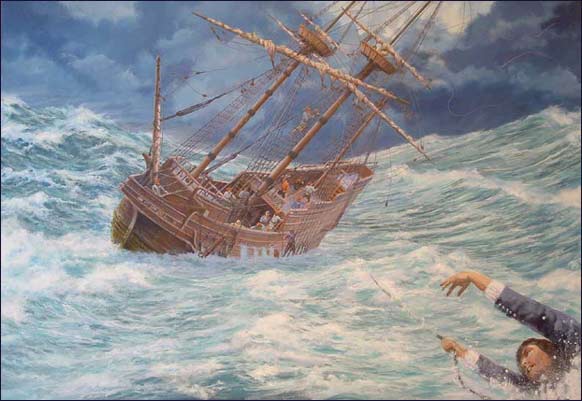
John Howland: John Howland was born about 1599, probably in Fenstanton, Huntington. He came on the Mayflower in 1620 as a manservant of Governor John Carver. During the Mayflower's voyage, Howland fell overboard during a storm, and was almost lost at sea--but luckily for his millions of descendants living today (including Presidents George Bush and George W. Bush, and Mrs. Theodore Roosevelt) he managed to grab hold of the topsail halyards, giving the crew enough time to rescue him with a boat-hook.


"Howland Overboard," a painting by maritime artist Mike Haywood. Giclee canvas prints are available from the MayflowerHistory.com Store.
It has been traditionally reported that John Howland was born about 1592, based on his reported age at death in the Plymouth Church Records. However, ages at death were often overstated, and that is clearly the case here. John Howland came as a servant for John Carver, which means he was under 25 years old at the time (i.e. he was born after 1595). William Bradford, in the falling-overboard incident, refers to Howland as a "lusty young man," a term that would not likely have applied to a 28-year old given that Bradford himself was only 30. Bradford did call 21-year old John Alden a "young man" though. Howland's wife Elizabeth was born in 1607: a 32-year old marrying a 17-year old is a relatively unlikely circumstance. Howland's last child was born in 1649: a 57-year old Howland would be an unlikely father. All these taken together demonstrate that Howland's age was likely overstated by at least 5 years. Since he signed the "Mayflower Compact", we can assume he was probably at least 18 to 21 years old in 1620.
John Howland had several brothers who also came to New England, namely Henry Howland (an ancestor to both Presidents Richard Nixon and Gerald Ford) and Arthur Howland (an ancestor to Winston Churchill).


Journey and Colony Timeline:
Beginnings & Proceedings 1620-1621
February 2, 1619/20 • Another patent, this time to “John Peirce and associates” is secured.

July 31, 1620 • The colonists leave Leiden for Delftshaven and from there to Southampton, aboard the Speedwell. At Southampton they meet the rest of the settlers and the Mayflower.

August 5, 1620 • The Speedwell and Mayflower set sail for the “northern parts of Virginia.”

August 13, 1620 • The Speedwell proves leaky and the two ships put into Dartmouth.

August 23, 1620 • After repairing the Speedwell, the two ships set sail. The ship continues leaking, and they both put back into Plymouth.

September 6, 1620 • The Speedwell and some of the passengers are left in Plymouth, and the Mayflower sails on alone.

November 9, 1620 • They spot the tip of Cape Cod, north of the land authorized in their patent. They attempt to sail south, but are defeated by treacherous shoals.

November 11, 1620 • The Mayflower anchors in Provincetown Harbor. The document now known as the Mayflower Compact is drawn up and signed by most of the men. This establishes a provisional governmental structure until a new patent can be obtained from the New England Company.

November 15 to December 7, 1620 • Parties of men go exploring in search of a good site for settlement.

December 8, 1620 • A party of explorers encounter Wampanoag for the first time on Cape Cod. Although shots are exchanged, no one is hurt in this “first encounter.” In the evening the men arrive in Plymouth Harbor.

December 11, 1620 • The shallop party lands in Plymouth and explores the coast.

December 16, 1620 • The Mayflower drops anchor in Plymouth Harbor.

December 20, 1620 • The colonists choose an abandoned Wampanoag village called Patuxet for their new home. The former inhabitants had died or been scattered in an outbreak of European disease four years before.

December 23, 1620 • Men go ashore and begin gathering building materials. Work continues as weather and health permit. During the winter, about half of the colonists die of scurvy and other diseases.

March 16, 1620/1 • Samoset, a Monhegan (Maine) Native, arrives in the colony and greets them in English.

March 17, 1620/1 • Samoset returns, bringing Tisquantum (Squanto) and announces the imminent arrival of the Wampanoag leader, Massasoit. Governor Carver and Massasoit conclude a treaty of peace. Squanto stays with the colonists.

April 5, 1621 • The Mayflower returns to England.

Mid-April, 1621 • Governor Carver sickens and dies. William Bradford is elected governor.

Late September/early October, 1621 • The colonists hold a harvest celebration. Massasoit and a number of Natives participate. Initial Growth, 1621-1627

November 9, 1621 • The ship Fortune arrives, bringing 35 new colonists, mostly men.

July/August, 1623 • Two more ships, Anne and Little James, arrive bringing almost 100 more colonists. Together with the passengers of the Mayflower and Fortune, they comprise the “Old Comers.” These early colonists often received preferential treatment in later colony transactions. 1623 • The colonists receive their own land on which to plant crops. November,

1623 • A fire destroys several buildings in Plymouth. An unknown number of colonists, having lost the homes and possessions, return to England.

1624 • A religious controversy centering around the Reverend John Lyford results in many leaving Plymouth for England or other areas of New England.

1626 • Plymouth builds its first trading house at Aptucxet on the southwestern side of Cape Cod. There they trade with the Natives of both Cape Cod and Narragansett Bay.

May 22, 1627 • The colony begins to divide its major assets, beginning with livestock. The resultant document lists most of the Plymouth inhabitants by name.


Tuesday, September 5, 2017

George Pierce Billings


George Pierce Billings (1827-1896)

George Pierce Billings, one of the pioneers of Utah, died at his residence in Manti on 2 Dec 1896, Wednesday night at 8:40 o'clock. The funeral was held in the Tabernacle on Saturday, Dec. 5, at 2 o'clock. George was born on July 25, 1827 in Geauga County, Ohio, and was 70 yrs old.
His father, Titus Billings, and mother, Diantha Morley, were some of the first members of the LDS church and joined the Saints in Kirtland, Ohio and later to Nauvoo, IL. They assisted in building the Kirtland and Nauvoo temples. George followed in his parents' doctrine and died a consistent Latter day Saint.
He was enlisted in the Mormon Battalion, but accidentally got his foot cut, so he could not go. He drove one of his cousin, Heber C. Kimball's wagons to Salt Lake Valley the day before he turned 20. He came to Utah with the first company of 147 pioneers on July 24, 1846. He arrived very near naked, tall, lean and even hungry looking with no shoes. Soon thereafter, Brigham Young sent him back with 9 others to help the Charles C. Rich company. Not long after, their food supply became exhausted and the springs were dry. George went out to see if he could find food. With his rifle he set out across the hills. His thirst was indescribable, but found a brackish pool that he drank from, but only made his thirst worse. He next came upon a wounded buffalo with coyotes tearing at it's flesh, George made a fire to keep the coyotes away and he drank the blood of the buffalo. This only seemed to make his blood boil, but did give him strength. He moved on and found a lone Indian who gave him drink and buffalo meat-which saved his life and by the next morning he felt more himself. He traded the Indian his gun for 200 lbs of buffalo meat and met his men and the Charles Rich company hidden in the willows near the Platte River. It is in this company that he first met Jerusha, who would later become his 2nd wife and assisted them back to Salt Lake City. He was then called by Brigham Young back to Missouri 5 more times to help others cross the plains and as a scout.
Single and free, he got GOLD FEVER when the gold excitement started in California; he went to the Golden coast for 2 years with many others from Utah, but returned penniless. When he returned from California he came to Sanpete, Utah and married Edith Patten, by whom he had nine children. In 1851, he was called to colonize Manti, Utah and in 1856 called again to settle Carson, Nevada. Returning again to Manti later.
He learned from his father how to build and helped build the Salt Lake Temple was a prominent figure in the building of the Manti and St. George Temples; cutting all the stones for the Manti Temple. He also did the greater part of the construction and stone cutting of the well built pioneer homes in Manti.
27 April 1856, he married Jerusha Lois Shoemaker, his second wife in polygamy. George and Jerusha had eight children together. Of George's total of 17 children with 2 wives, there are 13 living, the youngest being 18 years of age. Nearly all the children were at his bedside during his last hours and witnessed his death.
He possessed a large and strong body at 6'4" tall and was large boned with a big frame. He was intelligent, a leader and possessed a commanding personality. He made ditches, tilled soil and made bridges. It was said he could accomplish much work on little sleep.
His soul responded to music and was a naturally gifted baritone singer and musician. He was taught by his father to play the violin and every instrument in the band. His father, Titus was the first band leader and choir director in Manti.
Every man in Sanpete county knows Sheriff Billings, as he served the people in that capacity for about 40 years and held numerous other offices in church and city. He was the guest of honor of the Utah Press Association in their Pioneer celebration last July. George Billings' headstone notes that he "Held the plow that turned the first furrow in Utah." George P. Billings had 2 wives. His first wife was Edith Patten (Sister of Thomas Jefferson Patten Sr) and had 9 children:
Hannah Billings (1852 -1881), Titus Billings (1853-1905), Edith Georgianna Billings (1856-1939), Louisa Billings (1858-1911), George Pierce Billings, Jr (1861-?), Leonard Billings (1865 -1915), John A. Billings (1866-1867), Orson Billings (1869 -1925), Heber Billings (1870 -1870)
George Pierce Billings and Jerusha Lois Shomaker Family
His plural second wife was Jerusha Lois Shomaker, they had 8 children: Marian Billings (1857 - 1857), Nancy Billings Reid (1859 - 1928), Clara Isabella Billings Patten (1861 - 1944), Luella Billings Shomaker (1864 - 1957), Ezra Golden Billings (1868 - 1957), Diantha Billings Nelson (1870 - 1953), Eunice Billings Nelson (1873 - 1934), LaPriel Billings Sorensen (1878 - 1958)

 Deseret News, 11 Jan 1882, Wed, page 6


Sunday, August 27, 2017

Rev Edward Billing

Rev. Edward Billing, was a native of Sunderland which was previously called Hadley. He was born in Hatfield August 10, 1707 and was the son of Ebenezer Billings and Hannah Church. In 1713, the family moved to Sunderland, then a part of Hadley.

For several years, he was at Fort Dummer (Brattleboro) as a missionary to the Indians under the auspices of the Edinburgh Society for the propagation of the gospel.


He was Belchertown, Massachusetts' first minister having served the Congregational Church there in the years 1739-1752 and had graduated with honors from Harvard College 1731; he ranked number 30 out of 37. Received his Harvard MA 1734.

He Spent the next few years surveying and preaching on western frontiers.

The Rev. Edward Billings was ordained, probably, in 1739 and became Reverend May 7, 1740 for the town of Cold Springs (now called Belchertown, Mass); and in 1741 it was voted that money should be raised to pay the expenses of his wedding to Miss Lucy Parsons. 

In 1738, a meeting house was erected and was occupied as a place of worship, though the building was not completed until 1746. Since the early settlers were "greatly embarrassed by debt" they had to partially pay their minister in firewood. They did not finish their meeting house for eight years because of the lack of tax money. In 1752 there were fifty families; and Mr. Billings was that year dismissed for his views in regard to "the half-way covenant." When Rev. Billings was dismissed in April, 1752, the population had increased to 50 families in Cold Springs (Belchertown).


He preached for a time after his Belchertown dismissal in a place called Nine Partners in New York.


He was installed at Greenfield, Mass. as their new reverend on March 28, 1754 and had moved his family there. His brief answer to the call given him to settle there, follows : — 


" To the inhabitants of Greenfield : — I have taken into consideration your call of me to settle as minister of the Gospel among you, and thereupon determine to accept of it, though there be some circumstances attending my settlement among you that are far from being pleasing. I wish you may be directed by God in managing the important affair of settling the gospel ministry, and that I may be interested in your prayers, that when I come to you, I may come in the fullness of the blessing of the Gospel. Your friend and servant, 


Edward Billing. 


November 5th, 1763." 


He resided at a place called Stocking fort or Fort Stocking in Greenfield, where Mr. Abner Wells now lives. This house was picketed for defense, and soldiers were stationed there in the time of the Indian wars. He died within a few years after his settlement holding the position of minister until his untimely death in 1760. He was buried in the old yard on the brow of the hill, near Mr. OsterhOut's house, but no stone marks the spot. He lived at a place called Stocking Fort, on the Turner’s Falls road, nearly opposite Snow green-house. 


A new minister was installed in Greenfield in 1761.


He published several books most of his ministry discourses

From the town’s Petitions, and from others presented about the same period from the same source, we obtain these facts: that these settlers began to bring forward a permanent settlement here (Belchertown -previously known as Cold Spring) in July 1731; that between that period and 1736, inclusive, they had increased to twenty families; that in November 1740, they were but twenty families, and greatly embarrassed with debt; that they had sustained preaching five or six years with that number and under very severe trials. The first records to be found remaining of the doings here by these settlers, are under date February 1739, and relate to the settlement of the Rev. Edward Billing, the first settled minister in the place. Time or accident has removed a part of the record; what remains is a part of Mr. Billing's answer to the call of the people to settle with them in the gospel ministry. Rev. Edward Billing says, "The two hundred acres of land which cost two hundred and pounds, and one hundred and sixty pounds to be paid in work towards building, at present, and forty pounds more to be paid in eight years, viz. five pounds a year, all which is reckoned as settlement. After a consideration of the call and invitation which the people of Cold-spring have given me to settle in the ministry among them, I have, I hope, determined with a sense of my insufficiency for so great a work without di vine conduct and assistance, and with a dependence upon the Lord Jesus in that work in this place, and do declare my acceptance of your call.” Edward Billing. Cold Spring, February 22d, 1739. In 1744, at a precinct meeting, they appointed a committee to settle with Mr. Billing concerning the 40s for EACH FAMILY THAT COMES INTO THE PLACE, there being some difficulty that arose by reason of some families going out of the place. Mr. Billing's salary was one hundred pounds a year and his wood, but varied, as the value of money varied. In 1745 a vote passed in precinct meeting, that Mr. Billing's salary should be paid as to rising and falling of money as near to what Hatfield and Hadley pay to their minister (as may be,) Mr. Billing being present and agreeing to the same. The salary also varied according to the number of the families; one hundred pounds was predicated on twenty families; if more came into the place, an addition of forty shillings was made to the salary for each family. This was upon the principle that all were to be partakers in the support, as well as the benefits of these institutions — held as indispensable, not to a part only, but to all — and if so, the inference was irresistible that all should bear a share in their support. When the salary had risen to one hundred and sixty pounds, it was deemed sufficient. It was never to extend beyond that sum, and to be varied, as to the number of families, only when that number should be between twenty and fifty. It was a general practice in New England, from its earliest settlement till about the commencement of the present century, to connect with the call of a minister a stipend called a settlement, in addition to his annual salary. Such a stipend was deemed needful to enable him to sustain the expenses of living till the salary became due at the end of the year; this settlement, in amount, was ordinarily about the same as one year's salary. It is evident that the settlement connected with the call to Mr. Billing, was estimated at a much greater amount. As the lands and labor in building a house were estimated, they were about 400 pounds; the lands were unproductive and nearly useless. At the close of the first year after the settlement of Mr. Billing, May 1st, 1740, a vote passed, "to pay up Mr. Billing's salary annually to the first of May, and it is to be remembered that silver goes at twenty-nine shillings per ounce, and we propose to pay equal to that." This was called old tenor. In October, 1741, at a precinct meeting, a vote passed "that money should be raised in the next rate to pay the cost of Rev. Mr. Billing's wedding. At another meeting held soon after, a vote passed to pay Deacon John Smith one pound eleven shillings and four pence, for Veal had for Mr. Billing's wedding." Better, far better would be a dinner of herbs on such an occasion, with, the feelings that prompted these acts towards their minister, than a stalled ox and contention therewith. Such a vote, to pay for a leg of veal, for such an occasion, at this day, might lead some "to sign of," or cast a grimace-look at goodness such as this; for modish vice, with ease, can dart a sneer at virtues obsolete. Another vote passed at the same meeting, to pay Thomas Brown thirteen shillings for candle wood got for Mr. Billing. These acts, though trifling in themselves, spoke a language full of import; the spirit that prompted them, gave life and energy and martyr zeal and faith to persevere under trials most severe and discouraging. While voluntarily assuming on themselves these expenses, for the benefit of their minister, even to minute items, they had but scanty means; they were burdened with heavy taxes, and compelled to make great sacrifices for the support of themselves and their families. I give their own story in the case. In a petition to the General Court, they say, “Three quarters of the township is in the hands of five or six or a few more proprietors, who have drawn us into difficulties; and now seem to cut us off. Some of us who own 150 acres of land only, have been rated in a single rate over twenty pounds. Some proprietors (non-resident) own thousands of acres around us, and pay not a penny." They pray the government to allow them to raise a tax on lands of non-resident proprietors; this petition was dated 1741, drawn by Col, Timothy Dwight, of Northampton, who was the first signer; the petition was not at that time granted, but they persevered in their requests. In May, 1742, they petition again to the General Court for the same power, to tax non-resident lands. They say, "this township is a part of the equivalent land, so called; the whole was owned by a few gentlemen who bought it of Connecticut, and four fifths of it or more is now in the hands of these gentlemen, or others that hold under them, and live at a distance. About twenty of us have actually removed to this place with our families, and have settled a minister, raised, covered and glazed a meeting house. The minister's settlement is but half accomplished, nor has the cost of finishing the meeting house been yet expended (paid). The minister's house which we undertook, is neglected, and may rot down half finished; this is all discouraging. Our minister must leave us if we cannot have aid. “This petition prevailed, and leave was given to tax “all lands in the township, one penny an acre, to fulfil the contract with the minister and finish the meeting house." The embarrassed condition of the settlers referred to in those petitions, ******** the growth of the settlement. There was very little, if any, increase of population, from 1736 to 1742. After the power was granted to tax the property in just and equal proportions, to sustain their Religious institutions, which were indispensable to their prosperity, the settlement advanced, and success attended them. Some of the means which they took to secure and perpetuate success appear in their votes. One was an increase of the minister's salary, that his labors may not be lost. Another vote was taken to appoint a committee to see that there should be no disorderly conduct upon the Sabbath. With such vigilance, success attended them. The population, for ten years next following 1742, more than doubled. At Mr. Billing's dismission, April 1 752, there were 50 families or over. The causes which lead to the dismission of Mr. Billing arose from a difference between him and the church, as to the qualifications for church membership. A major city of the church had adopted the system of faith, known at the day, as "the half way covenant." More than forty years previously, a controversy had arisen on this subject between Rev. Increase Mather, of Boston, and Rev. Solomon Stoddard, of Northampton. This controversy had been carried on through the press; many of the New England churches were divided in opinion on the subject, Mr. Stoddard maintaining the “half way covenant " doctrine, Mr. Mather rejecting it. The occasion which raised the difficulty between Mr. Billing and the church at that time was the calling the council at Northampton for the dismission of President Edwards. That council convened, by letters missive, June 22d, 1750; this church received a letter requesting their attendance to sit in council, by pastor and delegate. A majority of the church refused a compliance, alleging as a reason, that they did not agree with Mr. Edwards on this point, (the half way covenant), and voted their unwillingness that Mr. Billing should attend the council. He did however attend, and sat in that council, as appears by their doings, contained in the life of President Edwards. In naming the members of that ever-memorable council, it is said, "The Rev. Mr. Billing, from Cold Spring, was present, without a Delegate." Mr. Edwards was ordained at Northampton as colleague pastor with Mr. Stoddard, Feb. 15, 1727. Soon after his dismission, difficulties arose here between Mr. Billing and the church. Several councils were called. This appears by records, though the nature of the difficulties does not appear by records; yet they do by other writings still remaining. These councils were called between June 1750 and April 1752, when he was dismissed. See note B* at end of the volume. He preached here a few Sabbaths after his dismission the same year. Afterwards, 28th March, 1754, he was installed as the first Pastor of the Church in Greenfield, where he died soon after (1760). He was a native of Sunderland. At the time of his birth, Sunderland was a part of Hadley. He was a graduate of Harvard College in 1731 — settled here (Belchertown) in 1739 — married Miss Lucy Parsons of Amherst, a sister of Rev. David Parsons, the first minister of Amherst in 1741. Rev. Mr. Billing died at Greenfield, about 1757 (1760) ; no record can be found of the exact time of his death. His estate was settled in the Probate Office, in this County ; closed August 1 760, when his widow Lucy was appointed Guardian to four minor sons, Edward, Ebenezer, Jonathan and Ethan, all under fourteen years of age. It is to be regretted that so little can be found, from which even a sketch can be drawn of his life and character. I have never found a person that knew him, and have sought in vain the monument to tell me where his body lies. Traditionary history imputes to him unusual energy of character, ardent zeal and devotedness to the work in which he was engaged. *There is nothing to be found on our church or precinct records, stating the nature of the difficulties that existed between Mr. Billing and the church, which lead to his dismission. I have in my possession, manuscripts one hundred years old, handed down from father to son, casting some light on this subject. A presentation of it is in the following document, under date of 1750: " In as much as many are endeavoring to destroy y Rev. Mr. Edward Billing's character, and prevent his being useful and serviceable to ye souls of our fellow men, we think ourselves obliged to let y world know ye following things, namely : that y rise and ground of y fierce contention at Cold Spring with Mr." Billing, was his differing sentiments from most of ye church with respect to y qualifications for y" enjoyment of y two sacraments, upon y account of his holding that none but visible Christians or saints were to be admitted to ye special ordinance. A great clamor was Taised in this part of the country, and church meetings were frequently called to prepare ye way for Mr. Billing's dismission ; and at last y° church and pastor agreed in passing ye following vote : ' The pastor and church at Cold Spring, being divided in their sentiments with regard to y qualifications which give a right to 'full communion' in y" church, when convened at ye meeting house, y° 2d Tuesday of September, 1 750, voted to call a Council, in a convenient time, to consider and give advice with regard to their difficult circumstances, resulting from y" above mentioned different sentiments. Voted, at a church meeting, 9th of October, 1 750, y1 y" business of y" Council, whenever called, shall be this, viz : to endeavor to accommodate the difference between pastor and church, and if the endeavors prove ineffectual, then proceed to determine whether pas tor and church, being of different sentiments as above mentioned, be a reasonable ground for separating them'." The Council convened, but I can find no result specified of their doings. The differences of opinion as to qualifications for the enjoyment of the two sacraments were not reconciled. I can find nowhere the point of difference between Mr. Billing and a majority of the church specifically stated, or the thing claimed by one party, and denied by the other. We have seen (page 16 and 17), that those embracing the half-way, covenants, admitted persons to baptism and to the church, as being in " a state of education," and upon a moral sincerity; yet did not admit them to "full communion" — that in form the church had distinct covenants, one for those thus admit ted, and one for such as were admitted to full communion. From all the sources of information that have come within my reach, I infer that Mr. Billing did not fellow ship this practice, or believe it to be scriptural. It is clear to my own mind, that Mr. Billing maintained that none should be admitted into covenant relation to the church, or entertained as members in any sense, but such as professed experimental religion. Such a faith as the half-way covenant churches required of those that were admitted to "full communion" — that none but such had any right, on their own account, to participate in the ordinances of the church. This question did not touch the right of infant baptism upon the faith of parents, but applied to those only who on their own account sought the privileges of the church, without any profession of experimental religion. I have found no evidence that this question which disturbed the peace of the church in Mr. Billing's day, and caused his dismission, was ever a disturbing subject after the settlement of Mr. Forward. The Articles of Faith adopted at his settlement, were those of the Reformation, and such as have ever been held by the church since. Other trials, however, were visited upon the settlers. The war between England and France, in which the Colonies were involved, was severe in demands on their time, service, and means of living ; heavy drafts for money and men were made repeatedly. In 1757 a draft was made for forty one effective militia men to go into that service as soldiers. The order was complied with. -"Historical Sketch of the Congregational Church in Belchertown, Massachusetts" FROM ITS ORGANIZATION, 114 YEARS, WITH NOTICES OP THE PASTOES AND OFFICERS, AND LIST OF COMMUNICANTS CHRONOLOGICALLY ARRANGED, TRACING GENEALOGIES, INTERMARRIAGES AND FAMILY RELATIVES. ALSO, EMBRACING NUMEROUS FACTS AND INCIDENTS RELATING TO THE FIRST SETTLERS AND EARLY HISTORY OF THE PLACE. written By HON. MARK DOOLITTLE. NORTHAMPTON, MASS. PUBLISHED BY HOPKINS, BEIDGMAN & CO. 1852.