Margaret was born December 5, 1863 at Brigham City, Box Elder County, Utah. She was the second child of Abraham Hunsaker and Katherine Jensen.
 |
| Maggie Hunsaker |
My father, Abraham Hunsaker, was born November 29, 1812 In Jamesborough, Union county, Illinois was a wonderful man, similar to the Abraham of old, in this faith, loyalty, and obedience to the Lord's commandments. He was a polygamist having five wives and fifty-two children. He was honest, ambitious, courageous, and very active and influential in the church, holding many high positions. At all times he was a good, kind and wise father to his children abut also firm and equally a kind and loving husband.
From the beginning of Abraham's conversion to the Church of Jesus Christ of Latter day Saints in 1840, he was always pioneering westward and started on the first trek and with the first group of LDS who came west to Utah. But about this time was the uprising in Mexico, when five hundred men from the church volunteered to fight in uncle Sam's army. Abraham was among them. They were released a year later at Los Angeles, and then made their way to Utah expecting to join their wives and children there. However about thirty of them were disappointed and Abraham was among them. So of course these men went back east as far as Iowa for their families. It was a most terrible journey for it was winter time and the mode of travel was by wagon or horseback or by foot. But after many hardships and nearly starving to death, tey made it and arrived back to Salt Lake in October 1848.
At this time, the Hunsakers had six children. They all endured many harsdships as did the other saints. Many were the tragedies experienced at their hands and especially with the Indians, among them was the cruel murder of abraham;s beloved son, Lewis. This happened around the south part of Utah Lake as they were herding cattle and Lewis, about thirteen years of age, was sent a little way off for a team of horses, when some Indians sneaked upon him, took him and tortured him to death, while Abraham and other men hunted frantically for him; but in vain. They could not even find the persons who did it, so that they could buy back the remains to give them burial.
My father was always prosperous and provided good homes for his families, homes which he willingly lift when called upon by Pres. Young, to settle other communities. He helped settle Brigham City, Utah then was called upon to settle Carson Valley, November then later was called upon to settle Honeyville, Utah. This latter place was called after him at first being called Hunsakerville; but this he said was too clumsy, and suggested it be called Honeyville, as a reminder of the Biblical land of Canaan flowing with milk and honey, as the people at this place had many beehives and many dairy cattle.
As Abraham believed in ambition, thrift, honest tithing, right living, etc he became a well to do man, leaving each wife with a good home and a means of livelihood when he died at age 77 years.
 |
| Abraham Hunsaker |
My mother, Katherine Jensen was a beautiful, dainty woman with a proud carriage, kind and generous especially to the poor and unfortunate. She was born in Norlundy, Galand, Denmark February 12, 1843. She died September 15, 1927 in Honeyville, Utah. She was eight years old when she sailed across the Atlantic Ocean with her Aunt Julia Jensen, as her mother had died in Denmark and her father had arrived in Utah. Katherine Jensen crossed the plains when she was nine years old and walked most of the way. Her father was Hans Peter Jensen and her mother was Anna Mariah Lawsen; both born in Denmark.
 |
| Catherine Jensen Hunsaker |
 |
| Abraham Hunsaker and Catherine Jensen Hunsaker family |
In Margaret's own words, " The first thing I remember of importance, was our home on the north side of the street just back of the present court house. It still stands, but of course it has changed hands a number of times and has been remodeled.
 |
| Brigham City Hunsaker home. |
 |
| Brigham City, Utah Hunsaker home. |
 |
| Abraham Hunsaker home in Brigham City, Utah |
The court house had just been built and it was there that I attended school for the first time. I think we started to school much earlier than 6 years in those days.
 |
Building where Margaret first went to school about 1867-8
The Box Elder County Court House was built in 1857. It was the first public building in the city. Before the walls were fully built, a strong wind knocked down a portion of the structure. It was quickly re-built. Beside being used as a court house, it was used for school, church meetings, and the basement was used for dramatic productions. |
My father owned shares in the Zion's co-op, he owned and worked a large farm and owned a large number of sheep and cattle. He owned and supervised two large homes, situated on main street, one block north of the Tabernacle.
Aunt Liza, Aunt Harriet and my mother, (father's wives) moved into the new home on Main Street, while Aunt Mary and Aunt Margaret, (father's other wives) lived in the other house. Each wife had her separate apartments and the rooms were large and spacious, with halls between and upstairs bed rooms. (no known pictures of Aunt Mary and Margaret)
 |
| Aunt Harriet Beckstead Hunsaker |
 |
| Aunt Eliza Collins Hunsaker |
 |
| Mother: Catherine Jensen Hunsaker |
There was love and peace between those women, in fact they looked upon each as sisters and treated each other as such. One regular event that stands out in my life vividly, was the togetherness of each wife and her children to prayer each morning and evening. Each wife was given her turn to lead in prayer, (it was termed being mouthed in prayer), and each child that was old enough was given his turn. Also father taught us the law of tithing and set the example to the letter himself. I remember hearing Pres. Lorenzo Snow saying that my father's prosperity was the results of his honest tithe paying and his great generosity to the poor and the sick.
I well remember the first calico dress I ever had and how proud of it I was. I had previously only woolen and flannel dresses. Our foot wear was somewhat similar, the kind we were born with, except on Sundays and special occasions, and then they (our shoes) were big home made clodhoppers. I knitted all the stockings I owned from the time I was ten years old; I also knitted them for my own family up to the time I had been married and had six children. We never bought stockings.
Father purchased 40 acres of land ten miles north of Brigham City, in what is now Honeyville. There he built each wife a good substantial home.
 |
| One of the Honeyville Hunsaker homes |
He also built and owned a sawmill and grist mill, bought large tracts of land and put every child that was old enough to work to help earn a living; his motto being: " An idle mind is the Devil's workshop." We girls worked in the fields pulling weeds, planting, hoeing, milking and did general outdoor work besides the indoor work.
When I was 14, I had quite and experience, our neighbors girls worked at the Brigham City Co-op Dairy located on the divide between Collingston and Logan, called the Valley View farm. These girls told me what good times they had there; so I was wild to have a change and have some fun. My parents were very opposed to my going for there was plenty of work at home, but I pleaded with them until they gave their consent and this they did only because they didn't think I would stay with it.
So I went but I soon met with a few obstacles that were far from fun. For my duties, I was handed a slip of paper stating that I must search out 25 cows out of 600 head and milk them. The cows each had a block of wood with a number on it fastened around their necks. Each girl found her cows in this manner. No boys were on the dairy except milk carriers and herders. I thought I was used to milking but the first night I found only 5 cows and milked them, then darkness came on and my heart was so heavy because I had failed to find the other cows. I was advised by the other girls to keep still and they would help me all they could. By the end of the fourth day I had found all my cows, but what I went through!
 |
Margaret's first real job.
Food enterprises, in 1874, included a model dairy at Collinston —
"perhaps . . . the finest, best and most commodious of any dairy in this
Territory" — consisting of 500 milk cows. Established in 1871, it was
reputed to be the first "commercial" dairy in Utah. In addition to fluid
milk, the dairy department produced nearly $8,000 worth of butter and
cheese annually. Almost 40,000 pounds of cheese were produced for
exportation alone in 1875. |
Every 5 out of 25 cows had to be tied by the head and legs, they were so wild, and that was the rules of the dairy. Some of the cows bags were so swollen and were very sore from being missed. After milking that number my arms and wrists were so swelled up almost as big as two. Finally I was forced to stop and nurse them back to normal. I did not reveal my condition to my parents until years after I was married. I learned my lesson that I should have listened to my parents, but I didn't give up and stayed the summer season. Another item I might mention, after our milking each night we made cheese till 2:00 am.
These cows were owned and sent to the dairy by different people all around the country as far as Brigham City, in exchange for cheese for family use. In the fall they were returned to their owners with the cheese. Our wage was .50 cents in cash each week plus $3.50 in home dues for furniture at the Co-op. For my home due for the summer I bought a dresser and I was very proud of it. The next spring the boss of the dairy picked me as one of their first girls. My parents would not consent and they did not know how glad I was they didn't.
When I was 16, I went to Dixie (St. George) with my brother, Israel, and his wife. He was called there by the President of the church to work the cotton farms. His wife had poor health so they had to keep a girl. They wanted me and I was willing to go, also were my parents. A number of other people were called (to the cotton mission). Among them were Lorenzo and Seth Wright who later went on to wild Arizona and were killed by the Indians. (note added; 75 years ago). Arizona was wild.
It was a hard life in Dixie, the cotton raising didn't pay so they had to give up. All the people left except my brother, and he resorted to raising hay, grapes and other things. He also established a feed stable at Silver Leaf, ten miles away at a mining camp.
About this time there was a small company of Latter Day Saints traveling south to make their homes in Mexico. They had come from Franklin, Idaho. Among them were Amos Hawks and his family, he seemed to be the leader of the group. He was the father of my future husband, whom I hadn't met yet, Joshua Hawks. Upon their arrival at Silver Leaf, my brother noticed how worn out their horses were and told them he had a good pasture at the cotton farm at which they might recuperate their horses as long as they cared to stay and it would be free. They gladly accepted the offer and stayed 6 weeks. This is how I met my future husband...
My brother was kind and considerate of me; he knew it was a lonesome life there for a young girl, so he had given me a very gentle horse for my own to ride as I pleased, this I enjoyed very much and I was young and happy, the world looked beautiful to me. One day after I had finished my work I went for a ride. Upon returning late in the afternoon and rode into the yard on a slow walk a strange voice said, " W h o a !" I started my horse up again as I hadn't reached the place I wished to stop and thought at the time this was my business. I started him up again, as I hadn't reached the place I wished to stop, I started him up again but after going only a few feet that same drawled out
"W-h-o-a!" was heard. When the beast stopped this time, I became real nettled and I thought I would show this smart-aleck his place by keeping the horse moving; but he seemed in partnership with the other fellow for no sooner had he started up when the third " W h o a!" was heard, and my nag stopped shorter than ever. This was awful......I looked around in anger and there stood the culprit not far away, a stranger, enjoying my embarrassment. This was none other than Joshua Hawks; (my future husband) he was good looking, but at that moment I almost hated him for his bold impudence. As time went on circumstances seemed to throw us together daily, and we began to think more of each other.
This was the longest period I had ever been away from my home, parents and friends, and I was so homesick, words cannot express those feelings. Many a night I sat in the moonlight and cried for hours. But there was nothing I could do about it for at that time t raveling was a problem and home was far away.
One day Josh (Joshua Hawks), asked me to marry him and go on south with him; as he was the eldest in the family at that time he felt that it was his duty to get his parents settled. At first this seemed out of the question to go farther away from my home and loved ones in Utah. Finally after much persuasion his Hawks persistence won out. I consented with the promise that he would take me home as soon as his people were settled in Mexico (but as the reader will learn, we never reached Mexico).
My father had great faith in my brother Israel, and had told him when we left that if I met a good man and wanted to marry, he must be the judge and all would be well. So when Josh asked Israel for his consent to our marriage it was willingly given and we were married in the St. George Temple by Bro. Cannon who officiated there at that time. He told us to remember that we were married by one of the big guns, I was 17 years old at this time, January 26, 1881.
 |
| Maggie and Josh soon after their wedding about 1881 |
Before taking my reader with me on our journey I should like to relate more about life on this cotton farm during my stay there. Many times my life was saved through prayer. I shall relate two instances. The town of Washington was 6 miles away and it was there we had to go to church and do our shopping. The Rio Virgin River had to be crossed each trip, six or seven times on account of its changing its course during the day and there were curved and perpendicular mountains on each side in certain places. It also had a treacherous bottom.
 |
| Virgin River near St George, Utah. |
Sometimes we would go to Washington in the morning and the river would be in its normal course, but going back in the late afternoon the course would be entirely changed and waves of rolling quicksand would be so high that we had no idea where the fording place had been, and it would seem impossible to make our way. At this time we would have to let the horses choose their own course. One particular time it looked as if we were gone. The water was swirling over the horses heads and bodies as they pulled our buggy, all we could see of them were their ears and noses. The water and quicksand had filled our white top buggy bed and we were forced to pull up our feet under us to keep out of it. We sat there praying for our lives and holding on as still, as we could sit for fear of unbalancing the buggy. My brother and his wife were religious and believed in prayer. Once the buggy tipped far to one side as if we were sinking. My brother continued to urge and encourage the horses on and we continued to pray aloud to the Lord to spare our lives. Finally after what seemed hours we reached the shore. We have talked of it many times since and feel that it was nothing but our faith and prayers that saved us.
This type of country was so so hilly that all the small pieces of land even as large as a good sized room was farmed. The cotton farm wound around the bends of the river and was a struggle for the people to exist. Every thing was made us of; lye was extracted from the creosote bush with which we made soap; even the greens were used for food. Flour was $8.00 a hundred pounds, etc. Yet I have never tasted better food nor have I ever seen more hospitable people. They would divide the last bit they owned with others.
Along with such trials as these the country was swampy and unhealthy which caused ague (chills and fever). Today of course, this condition is overcome by the draining of this land. But at that time very few people escaped the ague. I was one of the victims and it remained with me for five years, long after I had left the place. There was no cure for it in those days. It had to run its course. Not even the Indians were exempt from this disease. The few who were there almost starved to death. They were also of a mean, cruel, character and we were so frightened that we had to be on guard most of the time.
One day an extra big and ugly Indian came to our house and roughly demanded bread of my sister in law. She told him she had none, which was true. He marched boldly over to the cupboard and picked up a large butcher knife, raised it in the air as if to strike and said, " Now you give bread!" The poor woman turned as white as a sheet. I was afraid I was going to fall to the floor. But she went calmly over to him and repeated she had not bread but would give him something else and proceeded to give him the meat she had and some sugar. He went away satisfied. During those tense moments I stood praying fervently for her and for our protection, he was so menacing and cruel looking. I feel that God heard and answered my prayers; for Indians had been killing for much less than that. In fact in every case where they had the advantage such as this, they had killed. Another thing that made it bad, our house was built against the ridge of the mountain and the back door opened against it which made it so that we could not see where our men folk were at work that we might call for help. So we were looking for the Indians more or less most of the time.
There are many interesting tales I could relate such as these, but I will not take up my story where we began our journey to Mexico just three days after our marriage. My sister [in law] felt so down hearted to have me leave; she said she could not feel worse if I had been her own daughter; our love was mutual.
 |
| typical wagon train for the time |
This was a most terrible journey for there was practically no road at all most all the way; large rocks and boulders were every where. At times we would just have to hold on to the sides and brace ourselves to keep from being thrown out. Flood beds made great washed which we had to follow at times; at these places we women had to walk; in fact we preferred to, for the wagon wheels would bounce from one great boulder to another making head way so slowly. One terrible obstacle for me was my ague these chills and fever would come at regular intervals and these days I would have to stay in the covered wagon whether I liked it or not. There was the every day chill, the every other day chill and the third day chill; I had them all, and oh, so sick! My chills would be so hard they would shake the wagon and when the fever came after I would loose consciousness. No one knows what this is like unless they experience it.
There were many many hardships on this journey of six weeks. Cacti and prickly-pear so thick, it would scratch the sides of the horses until they bled. Watering places were few and far between. We were a small company of about ten wagons; two of the men had been over the route before and knew the watering places.
 |
| Maggie and Joshua took the Honeymoon Trail from St George to Mesa, AZ by horse drawn wagon. It took them 3-4 weeks to get there. |
At one period after we had traveled two weeks, our horses were very thirsty, having gone without water two days, we hauled the barrels of water on each wagon but at this time there hadn't been enough so we had to go down a terrible place called Granite Pass, in order to reach water by going another way forty miles further. We could have found water but the poor beasts were too thirsty and we had to make it down somehow. We women and a few men started down this almost perpendicular mountain; bracing our heals into the ground to keep from falling forward. At times we would have to sit down and slide holding on to bushes or anything we catch to keep from sliding to the bottom where we could see a lovely sparkling stream of water. Finally after traveling inches at a time we made safely to the bottom and oh, how thankful we were! Never did water taste so good! so cool!
Now our next problem was to get our wagons and teams down. It simply looked an impossibility, but after much talking and planning, my husband said, "I am the youngest man here so I will try it first." (there were boys just a little younger, but not younger men) Josh was 19 but now he was married and he considered himself a man. I was proud of his bravery.
The wheels were rough locked with chains and ropes; the other men bracing their heels into the earth, pulled back on the ropes with all their might which were tied to the wheels, while Josh sat in the seat of the wagon and guided the tram downward. What an awful sight that was as he sat there bracing his feet against the front and his back against the contents of the load, which looked as if all would slide on top of him as the outfit started downward.....Father in Heaven heard our prayers for in a while he reached the bottom in safety. Josh's mother and I told him we didn't want him to risk his life again by bringing down any more wagons; but he only replied, "I told the men I would bring them down, so I must." Accordingly he brought each one down as he did the first one.
Again we had an other frightening experience when we had to ferry across the Colorado River, with only a crude makeshift for a ferry which the men rigged up. Not one of whom had done such a thing before. But the Lord was with us again, and at last we reached Mesa, Arizona where my husband's folks decided to settle. This place was as level as a floor as far as the eye could ee, with no houses at all except two or three adobe ones with dirt roofs. For our house, at first we had only a wagon cover stretched across some poles, with a shade of brush built over the top for a shelter from the terrible heat.
We had a very difficult time to get food enough to exist upon until we could raise a crop. So after some thought and discussing with my husband. I wrote my good parents and told them about our plight. In no time, it seemed, there come a letter back with $150.00 enclosed. At that time, that amount would go far. The first thing we did, of course was to get a food supply, then build a one room adobe house for our own. There were no timber or shingles to be had for a roof, so Josh cut the Ocotillo ribs and Chaparall for that purpose, then he intended to put soil on the top of that as the final covering. This was 1881.
We had our little home all finished except for one last load of brush which Josh had gone after, when a most furious storm came up and washed the whole thing to the ground. I was standing in the front end of my tent watching it go down with a sad heart, when I noticed the water was coming through my tent and the poles which held it up were swaying and rocking back and forth. I could plainly see that it was going down also. So I snatched a wrap and ran out of the back entrance as it went down with a crash. It was about three blocks to any shelter and the rain was pouring down in torrents. The water was up to my knees already as I tried to run and held my skirts up; but it was hard making any headway. By the time I reached a hut it was like I had fallen in a river; in fact I thought I had been in a flood. This was the home of Saul Kimball, son of Heber C. Kimball. They welcomed me in and the storm suddenly ceased as it had come.
Footnote: storms such as these were common in Mesa Arizona at that time. At the present time, 1942 the vegetation, almost all the cacti and sauwea, have grown. also the grass which grew so high on the prairies that it was cut and used for hay. And the climate has changed somewhat, the sudden furious storms do not come as they used to and it does not seem as hot. The big Salt River is gone because it has been taken to irrigate the big Mesa, which has blossomed into beautiful orange groves, grapefruit and vineyards, etc. Also beautiful dwellings and other buildings. All this spread before us when we went back to Mesa 6 years ago to spend the winter. It was so interesting to see such changes in fifty years only. We found very few of the old settlers, about 18 widows; the country seems hard upon the men. I worked in the Mesa Temple while I was there, doing the work for 18 of the Hunsaker's family who names were there. I enjoy it very much. Josh was not able to go.
It had been almost a year since we arrived in Mesa and we had a fairly good crop and had saved a little money. So as Josh had promised me, he took me back to my people in Honeyville, Utah. This was a happy reunion, we arrived in the fall and the next April, a year and four months after our marriage, twins were born to us, a boy and a girl. But the poor little things were born with the ague, as I, their mother still had the disease. They lived only two days, this was in April 1882.
During the next year and a half Josh worked at the grist mill at Honeyville. Then our next baby was born June 1883, a very tiny, sickly little boy, due to my disease. However, in a year or so he grew to be a very healthy child and I was gradually getting better also. We named this child Amos after his grandfather Hawks.
When Amos was almost three years old, we moved back to Mesa Arizona where our next baby boy, Roy, was born in a tent in February 1885. We bought a little farm planted an orchard, built a little home and later built it larger. Josh and his younger brothers built a lime kiln and made brick and built the first brick home in Mesa City also the first church house and donated all the work.
About that time there came an epidemic of typhoid fever and with it we lost Josh's brother, Frankie [Franklin Levi died August 8, 1887], whom we thought so much of. Then I took down with the disease, recovered and nursed Josh through it, but he never got over the effects of it for months, in fact, as long as we remained in Mesa; the heat bothered him so much. He went down in weight to 135 pounds. As he was unable to work we became very poor. Then we had a new baby girl, Eva, [June 2, 1887] and my father sent us $100 which helped greatly. We liked it in Mesa, but on account of my husband's health we had to leave.
Escalante, Utah was our next home; this was a hard place to live but Josh's health was better. He and his brothers followed their trade of brick making and building houses, etc. We also had a farm run by a fired man. It was here my next three children were born; Frank 1889, Ila 1891 and Veda 1894.
As we were cramped in this place for land, we moved north with a group of people who were leaving; stopped for a while at Honeyville, then went on to Pocatello Valley, Idaho and took up land. This was also a hard pioneering life, each fall we had to move to Portage Utah (the nearest town), in order that our children might attend school and for four summers my older boys and I ran the farm while Josh worked laying brick on the Deseret News Building in Salt Lake City and other buildings to help out by getting the cash we needed. This was a large farm and there was lots of work. We stayed with it for fourteen years then sold it because we desired to live where we might five our children advantages. Four more children were born to us during this time. [Wallace 1896, Lafayette 1899, Nevada 1904, Berlin 1908] Twelve children altogether.
 |
| Joshua Hawks and Margaret Hunsaker family. Twelve children in all. |
Then our oldest sons's wife died [note Vilate didn't actually die, she was in poor health and couldn't take care of the children this was about 1918-1919] and we took his five little children, raised and loved them as our own. We lost the three younger ones with scarlet fever, but the other two are now grown and married and having their own families as are all our own children, except two whom we lost some years ago, also six years ago I lost my husband after we had spent a year in Mesa, as his health was failing we intended to spend our winters down there. Since then I have lived a lonely life, although my children try to get me to live with them, I am now 79 years old.
 |
| Joshua Hawks and Maggie later in life |
I should have mentioned earlier in my story that the land we took up in Pocatello Valley, Idaho was in its native condition. There was absolutely nothing there except safe brush and wild growth; not even water. We had to pipe our water from the mountains and clear the land before it could be worked. And most anyone knows that pioneering means hard work, struggle, and sacrifice; so I am glad it is behind me.
"However, I fear the time will come when future generations will not read or appreciate what pioneers did in paving the way, and laying the foundation for all the modern conveniences and luxuries and plenty of everything which comes so very easy."
 |
| Maggie Hunsaker Hawks (1863-1947) |
But the Lord has blessed us bountifully and given us health and strength to carry our burdens, and we have had our joys as well as our sorrows, so we are thankful for all.
My desire is that my children live clean, righteous lives obeying all of God's commandments, then I know they will be happy."
Maggie's gandson, Carroll D. Williams added a memory, " My grandmother Hawks took the championship for motion sickness. Whenever we traveled with her, we had to stop every five to ten miles for upchucking and trying to get any great distance she would actually pass into unconsciousness and be deathly sick. A few years later grandpa Hawks found out that to have her elevated in the front seat of a pick-up, she could manage better.
Margaret Hunsaker Hawks died at age eighty-three at her daughter's, Veda Hawks Gunnell, home in Tremonton, Utah. She was buried at Portage, Utah.
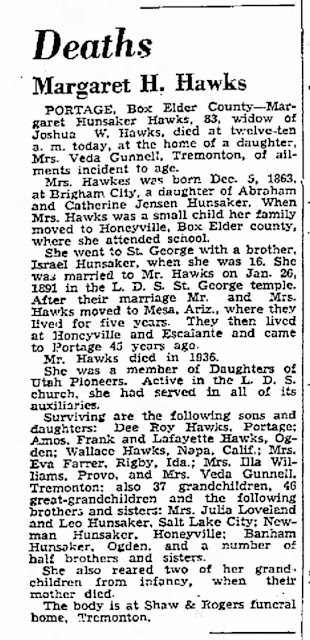 |
| Margaret Hunsaker Hawks obituary
The Ogden Standard-Examiner, 12 Mar 1947, Wed, Page 14 |


