Sunday, August 27, 2017

Alton Craig Curtis

A. Craig Curtis (1943-2011)
Alton Craig Curtis was a beloved son, father, grandpa and friend. He was a dreamer. He was tender hearted, kind, imaginative, inventive, creative and talented in many ways. His brother Mark recalls: "He had a very good sense of humor and could turn a dull moment into a happy one with his imagination and wit." His cousin, Kelly adds: "He had a genuine and captivating smile that made you feel glad you were with him." He could make something out of nothing. He had strong work ethic, morality and was a free thinker. When others were living their lives by the book, he chose to live by the calling of his own heart. This is not an easy task; following your heart. It takes great courage to trust in one's self and because of this; he was greatly misunderstood by many people. His father relates: "Craig was not the ordinary person, he was different. That said, it isn't necessarily bad. And many of us have come to the same conclusion, that he was extraordinary. " He had a great love of the performing arts, comedic acting, song and dance in particular. In his school years, dad was a cheer leader and took tap dance classes. In college, he even majored in dramatic arts. As an adult, he had a stint with karaoke. He took singing seriously, practicing his songs at home before he went and performed them publicly. Dad was a writer of stories and enjoyed reading stories allowed in a theatrical way. He was a natural actor. Dad was left handed, and we heard him say more than a few times;"Lefties have Rights too!" Alton Craig's legacy: JoAnna invited Alton Craig to a workshop in February of 2010. They were instructed to have the invited person partner up with whoever invited them. So mom and dad were partners. Then they had to ask each other this question: "what is it that you would like to acknowledge about me". Mom's response to dad was "I think you would like to be thought of and remembered as a good and valiant man and for your posterity also- although they never knew you." It took dad a moment, but he wholeheartedly agreed. Alton Craig and JoAnna's wish is for his children, grandchildren and future posterity to know him for the good and valiant man that he was.This is his story.

His story begins with his parents and siblings: Samuel Frederick and Emmeline Hastings Curtis:
Emmy and Fred

Fred and Emmy
Alton Craig's parents both grew up in the desert region of Arizona under very stringent circumstances - this is where Craig's story begins. His mother, Emmeline Hastings, had blue eyes and brown hair and was born at home on a farm December 2, 1913 in Mesa, AZ to her parents Joseph and Amanda C. Kempe Hastings. She died at home May 19, 2005, Mesa, AZ. Emmeline recalls: "As a youngster, I was tall and "leggy" and thought that was just fine as people "looked up" to me." She loved animals and the outdoors, but understood the need to eat and was not afraid to hunt for food. In 1933 she attended BYU for 2 years and transferred to and eventually graduated from Arizona Normal (ASU) in 1936 and secured her first teaching job in Solomonville, Arizona. She taught there for three years and then moved to Safford to teach two years at the Jr. High. This is where she met her future husband, Fred. Family and education were very important to her. His father, Samuel Frederick Curtis, was born June 22, 1918 in Safford, Arizona to his parents Ammon and Mary Jane Slade Curtis. Fred recalls: "On May 20, 1936, I graduated from Safford High School. There 2 were 46 of us in the class. We went down and had a party by the river and as boys will be boys, I climbed up a cottonwood tree; too high for safety. It was not strong enough to hold me and I fell, right down to the ground where I landed on my feet. I heard a pop as if a limb had broken, but it was the cartilage breaking in my knee. It swelled up and never went back like it was before and from then on, I had to favor it. This one incident affected the rest of my life." November 1938 he was called to serve a LDS mission in Germany. He was only there a few months when war broke out and he was transferred to the northern states of Ohio, Illinois and Indiana to finish his mission-November 1940. While he went off to serve a mission, Emmeline waited. It seems she couldn't wait very long because Emmy made a trip to New York with some of her friends to have a visit with Elder Curtis who was still on his mission.
Arizona Republic, 09 Mar 1941, Sun, [First Edition], Page 27
And when he returned, the friendship they shared before his mission took a serious tone, becoming a courtship and were married May 28, 1941 in the Mesa, Arizona Temple. They started their family in Mesa and finished in Blythe where they lived for 34 years. They were years of hard work and struggles.
Alton Craig loved his mother and father very much and was close to them all throughout his life. Together, Samuel Frederick and Emmeline Curtis had 6 children; 3 boys and 3 girls. Sam born April 8, 1942, Alton Craig born August 26, 1943, Carol Kristen, Claudia  Jerrell Mark, and Gayle.
Baby Craig and Emmeline
They were a close family who loved each other very much and still do. Growing up, there were many adventures with rattlesnakes and guns and dinner time laughter. Claudia Curtis Lines remembers "I have wonderful memories of mealtime around our dinner table while growing up...everyone sharing their day and activities. Dad would give observations of his day on the farm, the people he met, the animals he observed like snakes, the mountains and their beauty, the weather, the breakdowns of the pump...and life in general always leaving us with the feeling that tomorrow would top that day. Craig would always be engaged in adding comments that would send us into gales of laughter. We left the table feeling loved by each other and loved by our Father in Heaven and grateful for our family. I looked forward to the next evening for the fun we shared!" Thank you Craig. His brother, Mark recalls: "Craig was a good friend to me. He listened and kept his opinion about things private but let me go on and on about what I thought. I was always welcome at Craig's home.
back row Emmeline holding baby Craig, Fred is behind far right
He was quiet yet I knew things were going on in his head. There was a divine discontent inside that I could not stand to keep quiet about sometimes. When I tried to penetrate his shell to get inside and have a joust or two, he quickly shut the occasion down by changing the subject or not saying anything. He did not like to quarrel or exchange barbs with anyone. He wasn't good at it nor did he get any satisfaction from winning any of those kinds of conversations like many people do now days. I respected that and never tried to engage him again. Craig and I had many things in common. I found that I was very much like him in some ways. When I was little, I found that I would stand down rather than engage anyone with negative talk. I too, did not like to joust or exchange barbs. I did however find that I needed to express myself and disclose my thoughts, unlike him. Craig sent me pictures of his family as they came to him and JoAnna. I treasured those pictures and loved to look at them. I enjoyed his family as they grew up. We had Sunday dinners together and went on picnics at the park. We enjoyed the company and had many enjoyable times singing and playing the piano. Later in life, as things changed in his family, I still loved to be around him. I always gave him a big hug when I left his house on visits. I always called him my big brother because that was how he was to me. We never did agree on very much. Even though that was the case, it never bothered me, because he was doing what he wanted to do and being the way he wanted to be. It did bother me in a sense that I still couldn't figure him out, but I learned to accept him as he wanted to be in his life." His sister Carol Hatch relates: "Craig lived swiftly and fast in many respects. I can remember him as a little girl following him around and I guess I was in the way because he would tell me to "go away". Some of my most fond memories were at the dinner table. We always had dinner together. I do not remember our dad having to travel much and be away he was always there for the good meals our mother would prepare. We would start a conversation about some subject matter and Craig would pick up on some comment and turn it into something funny. It seemed that it would be that way for years; he was our entertainer, and a good one. I can remember once he made the comment that he wanted to be a radio announcer. I thought that when he got back off his mission he would pursue that field of study, Communications. Our table in those days was long and oval shaped, with tube of metal welded to the backside of a disk. The top was Formica; it was the perfect table for our family. It was comfortable and allowed us to move around it and even clean in all the corners. We were very happy and enjoyed our meals with dad's many stories of rattlesnakes and then Craig would leave us with a smile on our faces. I still smile about those times. I remember the Saturday meals of good beans and homemade hot bread. Emmeline's bread would last for a week.
Craig middle with his sisters Carol and Claudia

Darling Craig on left, brother Sam right

Fred holding his girls and Craig far left
We would come home from school and have cinnamon toast or toast and jam, or toast and honey. We were skinny in those days because we walked everywhere. Sundays for years we had either big juicy hamburgers and potato chips or Mom's special meat loaf. OH the good times. The fond memories. Craig was full of ideas and life around him was interesting and he made everything seem fun. He was the older brother that smoothed everything over and we moved on. He lived fast in the service for our country. He gave up time and put in the effort to defend; this made changes come into his life. I have to this day felt bad because he came back different. I respect him for the service rendered in the armed forces. He came back quieter and much more reserved, He joked around but with a different twist. He was still good at making one laugh. He is a brother, a father, uncle and grandpa. He deserves to be addressed as such. It shows respect. I feel at this time he will have some degrees of happiness and his memory of his life's contribution on this earth will be remembered for how he treated each one of us. He was kind and respectful to Fred and myself and showed this same respect to our father. He was a big help to him and was always ready to be by our father's side. I thank him for being my brother and for being a part of our family. I thank him for being a father to 8 children. He has such beautiful children and grand children. May we always remember the positive side of him, I know I will and I hope the next life will be a teacher for him and things will improve to be better. Thank-you Craig."

His father shares further insight to Alton Craig's life: "After coming home from his service in Vietnam his personality took on a more serious tone. He was not quite so light-minded; he was a little more quiet, prone to have his own thoughts. To show this trend in his personality, allow me to relate an experience in his life. While living in Ehrenberg Arizona, with his family, he was hired by the State of Arizona as an 4 inspector. Everyone was delighted that he had found this promising job. But his stay there was not to be. During the breaks in his daily tasks there, and in the less busy times, he did not blend into the sociality with his coworkers. He cared not for the small talk, he cared not for the off-color jokes nor smutty language, but preferred to read or to indulge in his own thinking. He was dismissed from his duties as a non-compatible employee. Was it unacceptable behavior? Not really. Just positively different, a good indicator of his righteous upbringing."


 His arrival: Alton Craig Curtis arrived at 6:50pm on August 26, 1943; a Thursday. He was delivered at Good Samaritan Hospital in Phoenix, AZ weighing in at a healthy 8lbs, 9oz and 21 inches in length. He fell in line as the 2nd oldest of 6 siblings. Emmeline writes: "He was a congenial, cuddly and easy going baby and grew up to be a fine young man." His father, Fred remembers his arrival: "...August 26th is the day Craig came into the world, I well remember the day. Craig would be our second son just 16 months after Sam was born. We looked forward to Craig's coming, because he would be a playmate for his brother Sam and his cousin Kelly. That hot afternoon, my brother Mel and I were castrating a newly purchased load of young pigs as we were in the hog feeding business. So on that afternoon Emmeline drove up with her suitcase packed and in great pain, she motioned for me to come to her. Craig had decided to come. We had agreed that if she had to go to the hospital before quitting time, I would drive her. Well the tasks of finishing our job at that moment couldn't wait neither could the new baby. The pigs were squealing, Emmeline was moaning and groaning with pain and I was stinky and dirty. I really had no choice, Craig took priority. I left the hogs with Melvin. I jumped in the car and we started for Phoenix which was 20 miles away. The highway went right through the middle of Mesa and right to the middle of Tempe, a two-lane highway. Just before we got to Tempe, I became drowsy, I couldn't seem to shake the sleep off, even with Emmeline's moaning and groaning and urging me to hurry. So we changed places and she, that brave lady, drove herself on to the hospital, with me trying to get a wink or two so I could help. It's hard for me to understand why I wasn't excited, and with the excitement, I couldn't stay awake. It's no wonder that Craig came into the world sleepy, with that kind of an example. Well what do you know, as soon as we arrived at the hospital and checked in, Craig gave up the effort. He gave up his insistence and settled down. It was a welcome relief, to pause for a moment and rest. But there I was still stinky and dirty. The doctor could not tell us when Craig would arrive. Emmeline and I, had a word of prayer for direction. It was decided that I should go back home. Emmeline was in good hands, Craig had gone to sleep, and I needed a bath." Baby Alton Craig was delivered without complications. It is interesting to consider the setting where Alton Craig spent the first eight years of his life. His father, Fred, describes the conditions under which the Curtis Family was living at the time Craig was born: "Emmeline and I were living in a one room cabin, described as Rambo's cottages, at the corner of Main & Greenfield roads (a rural area at the time). It had one double bed, two chairs and a small table, a kitchen with a sink and stove, a shower and a stool, which occupied the space of about 12' x 25'. If either of us wanted to change our mind we had to go outside to do it. Sam had a small crib. Now with Craig coming, there just wasn't any more room in that cabin for one more kid. We couldn't stack them up, there wasn't room under the bed, and we couldn't have them sleeping with us, because I was sleeping over against the wall and had to climb over pregnant Emmeline to get to the bathroom. We had only one option and that was to build something. It was during the war and we couldn't buy cement, we couldn't buy lumber for housing. But we could buy something for the pigs. So I checked it out, and sure enough, the rationing board would allow me to buy a load of lumber from Oregon. So, we built the house with part of the lumber we bought for the hogs. We dug a basement with a slip scraper, shovel and pick. We did most of the work, we scrounged for other things we needed, at a total cost of $750. It was completed about six weeks after Craig arrived. He didn't require money, clothes, or much space. Our joy was full, we were able to manage our affairs. We were able to stay out of debt, we had a new house and we did what we had to do with what we had and were happy.
The Lord had blessed us. Now we had a place for Craig. From the time Craig was born, until he passed on, more changes took place in our society than had changed in the previous 5000 years. So Craig got in on some of the old lifestyles that, at present, made part of his life look primitive. There were no cell phones, television was just being talked about, we still used the telegrams, and the crank telephones and the outside toilets. Rubber tired tractors were well on their way to becoming common, we still used hay hooks and pitchforks. And the list goes on and on. What I want to point out is, Craig could literally look back on his life and say, I lived part of my life in the good old days." Excerpts from Emmeline Curtis journal-May 1946. "Cars are passing here constantly- I don't pay much attention to them. While sitting at the table one morning, Craig said "There's the paper!" I looked out and there passed the carrier's car. Then while washing his face one evening, he couldn't see outside but suddenly said, "There's the paper!" And it was! Pretty good for a 2 1/2 year old child to recognize the sound of a car." -January 3, 1947.


3 year old Alton Craig came down with the measles. "Craig was as sick as I ever want to see! His temperature was 103.9 and for 2 days and nights he neither slept nor ate. His lips are still cracked and burned. Saturday morning, he was as red as a beet as tho it had been burned and blistered. Measles are a terrible ordeal for a little child!"
- February 1948 was when 4 year old Alton Craig was learning to ride a horse. "David Roberts was trying to teach him and put him on the animal all alone. In his enthusiasm, he kicked his legs against the horse to "go" and away the horse went with Craig screaming! He eventually fell off onto the gravel road and received gravel burns on his forehead, nose and chin and cut his mouth on the inside. Poor kid, gets all the hurts! Recently, he fell off the barn onto a piece of tin and cut himself quite badly. It was an inch long gash and 1/2 inch wide. He was a brick about taking three stitches with gritted teeth and watched every move.” His sister, Carol Curtis Hatch recalls, "When I was very young, I would follow Sam and Craig around when they would play. They were always telling me to go away; I would be a bother to them. Sam and Craig would go outside and play cowboys and Indians. I can still remember them with their guns in their holsters. Kelly was one of their playmates, the big threesome. Craig would be nice to me at times. I liked that he would have a little compassion for my feelings." 6 As a child, Alton Craig's family lived close to Uncle Mel Curtis, and as young cousins do, Alton Craig, Kelly and Sam loved to play together. Kelly Curtis reflects: "I treasure the home movies of Sam and Craig and I playing and having the time of our lives together. One in particular is of the three of us on one horse riding through the fields next to their home. It was not unusual to find us roaming the fields and the huge citrus groves together that surrounded our homes. A great pass time was finding bird nests in the citrus trees and carefully climbing up to see the different colored bird eggs or the different growth stages of the baby birds. Alton Craig was always the one to see that we were careful not to touch them and to protect their privacy. I remember the huge cottonwood trees along the ditch banks and how we found adventure in them and seeing how high we could climb before our fright took over. There were the wood-pecker holes and the owl holes in the trunks of the trees where the discovery of their eggs and babies always thrilled us. We had to be careful of the yellow-jacket nests or bee-hives as we learned early on not to disturb them lest we would again experience those unforgettable stings. Hardly a summer day would go by that we were not found playing or wading in one of the hay fields or irrigation ditches. On those hot summer days we could always count on the water to be cool and refreshing.

- February 1948 was when 4 year old Alton Craig was learning to ride a horse. "David Roberts was trying to teach him and put him on the animal all alone. In his enthusiasm, he kicked his legs against the horse to "go" and away the horse went with Craig screaming! He eventually fell off onto the gravel road and received gravel burns on his forehead, nose and chin and cut his mouth on the inside. Poor kid, gets all the hurts! Recently, he fell off the barn onto a piece of tin and cut himself quite badly. It was an inch long gash and 1/2 inch wide. He was a brick about taking three stitches with gritted teeth and watched every move.” His sister, Carol Curtis Hatch recalls, "When I was very young, I would follow Sam and Craig around when they would play. They were always telling me to go away; I would be a bother to them. Sam and Craig would go outside and play cowboys and Indians. I can still remember them with their guns in their holsters. Kelly was one of their playmates, the big threesome. Craig would be nice to me at times. I liked that he would have a little compassion for my feelings." 

As a child, Alton Craig's family lived close to Uncle Mel Curtis, and as young cousins do, Alton Craig, Kelly and Sam loved to play together. Kelly Curtis reflects: "I treasure the home movies of Sam and Craig and I playing and having the time of our lives together. One in particular is of the three of us on one horse riding through the fields next to their home. It was not unusual to find us roaming the fields and the huge citrus groves together that surrounded our homes. A great pass time was finding bird nests in the citrus trees and carefully climbing up to see the different colored bird eggs or the different growth stages of the baby birds. Alton Craig was always the one to see that we were careful not to touch them and to protect their privacy. I remember the huge cottonwood trees along the ditch banks and how we found adventure in them and seeing how high we could climb before our fright took over. There were the wood-pecker holes and the owl holes in the trunks of the trees where the discovery of their eggs and babies always thrilled us. We had to be careful of the yellow-jacket nests or bee-hives as we learned early on not to disturb them lest we would again experience those unforgettable stings. Hardly a summer day would go by that we were not found playing or wading in one of the hay fields or irrigation ditches. On those hot summer days we could always count on the water to be cool and refreshing.
Growing up: Life was full of fun and big smiles. His father, Fred remembers: "We were living on the ranch, on the corner of Val Vista & Transmission Rd., We had just returned from Sunday School. Sam and Craig were at that time heavily involved in six shooters & Indians and the day before we had bought them each cowboy boots, which they wore to Sunday School. It had rained while we were away. Well the minute they saw the puddles of water, they scampered out of the car and headed right for the water puddles, wading thru the water puddles in their Sunday best meant nothing, they waded with glee, they were doing just like Daddy. Well Emmy and I almost lost our religion. (Note, I wore rubber boots whenever I worked with the hogs. And coming back to the house, I always took every opportunity to cool off hot boots and wash off stink, by wading thru any water that might be available. So the miss-imperceptions of the ever observant tagging boys, was, all boots were made for wading in water.) About this same time, I was irrigating the alfalfa near the house & made frequent trips to the field to check the water. On that day Kelly, Sam's and Craig's cousin, who lived only 1/4 mile away, was visiting & the three boys were my charge. They were about 5 or 6. Craig was just a little shorter than the others, 16 months younger, but he was fast catching up with them. Sam and Kelly would always remain the leaders while Craig would be the supporting member of the threesome. This scenario prevailed for the next several years: Craig was the follower, not the decision maker, and in my opinion, was a key element in shaping Craig's future. He was the supporter, the shadow, the backup for others. Consequently, Craig began to think of how he could get things done, by himself, no support from others, he began to think and do on his own. He gradually began to think and do by himself, he felt comfortable doing & thinking on his own. It isn't a bad trait; it's just not very handy.” When Alton Craig was 12, his family moved to Blythe, CA where there were lots of adventures with horses, walking on stilts, guns and rabbits in the arrow weeds. Not to mention fishing, swimming, boating and exploring in the Colorado River. There was hard work on the farm, but there was fun too and most of all there was love. Alton Craig's brother, Mark recalls; "Craig won a nice bicycle at Imperial Hardware Co. It was a nice red 3 speed and had a carrier on the back. He got mad at me for lowering the seat and riding it. It was the bike I learned to ride even thou it was too big for me." Alton Craig was a typical little boy when starting school. Emmeline has written a few stories about his first year. -September 7, 1948 was 5 year old Alton Craig's first day of school Miss L. Dean was his teacher. Emmeline writes: "He rode the bus with Sam and was as proud and big as you can please! Later, I came to his school room and saw he was panicked and the flood broke and he cried and cried and said he wanted to go home. But, I made him stay at school and by the end of the day was OK."
-October 26, 1948. "Craig isn't doing so well in school he got a "U" in use of crayons, use of scissors and in work and play harmoniously and needs his tonsils out immediately." 8 HIGH SCHOOL: As a senior in high school, one of his favorite activities was to go shooting and skiing on the Colorado River at Cibola with his buddies, Alvin Stover and Nick. He graduated in the Class of 1961 Palo Verde High School, Blythe, CA. Life wasn't all play, he worked hard too. During his high school years and into his adulthood, he was very involved in the farming operations with his dad. Alton Craig relates a story about hard work in a letter to his dad, June 17, 1988: "While in High school in the summertime, I was helping dad cut hay with a sickle mower, before the days of swathers. I cut 40 acres in one day without breaking down (me or the equipment). Dad said none of his hired help ever did that before. I felt rather special for sometime after and I think he got some good mileage out of it also. We felt good about each other and I felt good about helping. I have used the same idea in helping my own children feel good about themselves and what they are doing. I draw strength from my dad and mom knowing they have been true and faithful in all things. I love them both very much."
 His father, Fred recalls: "I believe that I spent more time with Craig, than with any other of my children. He and I built a house together. We did real estate together and we developed the upper and lower ranches over a period of time. All this time, together, proved to be a very pleasant experience. We planned out our day and most usually followed our plan. We always knew what each other was doing. I don't remember a cross word between us. If we had differences of opinion about a certain procedure we worked it out. He always respected me, and of course I respected him. It was a joy to work with him. This team spirit had developed between us over the entire span of his life time. When he was younger, there were times when a good tongue lashing or a swift kick in the posterior would have been in order, but I could never bring myself around to do either." Not surprisingly, Alton Craig was a cheerleader his Senior year, was on the yearbook staff assigned to cover clubs and activities and was a copy editor. He was also involved in the House of Representatives (student body government) his Junior year in High School. These are more examples of dad's wide range of abilities, talents and interests. He really had so much going for him, good looks, intelligent, popular, could fix anything. It seemed he could do it all. His brother Mark relates: "I went to the football games at Scott Stadium at the High School and watched Craig cheer with the cheerleaders, (George Amerman was one of his cheerleader friends). It never occurred to me why he wasn't playing football or one of the sports. He was doing what he wanted to do and that was good enough for him." and his sister Carol writes: "I remember the year he was a cheerleader. The girls just loved him; he always had a lot of attention, always smiling. He was a good cheerleader. He was very popular and did not lack for friendship."
In High School Alton Craig bought, refurbished and drove a Model A car, it was quite the rave at the time, not just for his friends, but his family too! Dad writes: "I overhauled the engine, painted and drove the car my senior year in High School". 9 His brother, Mark, has a little more to add about the Model A: “Craig bought a Model A Ford out in the country when he was in High School. I took very keen interest in it too. He paid $100.00 for it from a man who lived out on South Intake Blvd. down past where the Kindred Harvey’s used to live. It was a 1928 2 door Sedan cloth top model. He took it over to Shepwell’s on the corner of Intake and Riverside Dr. and had it sand blasted on the underside to take off the rust.

He painted it dark green with black fenders. It was in perfect shape and he drove the car his senior year in High School." In a letter written to his brother, Mark from VietNam, Alton Craig writes: "Really Mark thanks for your crazy letter. I enjoyed all the latest news and was particularly pleased to hear your report on the model A. I wonder about it all the time and I appreciate your taking care of it for me. Brings me a speck of peace of mind.- Craig" After he came home from VietNam, he needed a car to go back up to college at BYU. Fred asked Mark if he'd give Craig his savings of $900.00 he had for his mission to go and buy a good car. In exchange for the money, Mark would take the Model A and that's just what they did. His sister Carol relates: "Craig had a special project in the back yard during his high school years. Actually he had several projects. One was his model "A" Ford and the other several were science projects.
He put together a dog skeleton and a horse skeleton. He was pretty good at connecting all the bones. I stood back and thought he was a VERY SMART person. The other project he had in the back yard was an old car that he very methodically fixed up, both inside and out. He finally made it run and he took us for rides often. I loved the way people would look at us and smile a big smile and have big eyes. I was just still a shy little girl admiring a big brother. Craig liked the reaction on people's faces too because he was smiling with a big grin as he drove; I guess you could say happy with having accomplished something."
mission companions and brother. Elders Curtis
LDS Mission to Texas -September 1962-September 1964 Letter from Elder Craig Curtis to his father while on his mission. August 8, 1963 "Dear Dad, Thanks for the letter you wrote to me. I love to hear from you. You always seem to have something good to tell me about the family or what you are doing. I don't think I can ever remember you being in a negative attitude very long. When we had a break down with the equipment, you always seemed to be calm and cool headed about it all. Thank you for preparing me when I was small to serve a mission. At times I stop and think "Is this what dad would do?" I'd like to thank you for all the good examples you have set for us kids especially Sam and I. It has enabled us to make many good decisions, and you have helped set our goals and values. Mom was worried about the money she sent for August. I received it and it's in the bank. I will use it as you have taught me to use money, and that's sparingly. My love for you and mom grows more as time goes on. Be sweet, I love you all, -Elder Craig"
1964 in the Texas Mission. He loved his mission and had a firm testimony of it during this time in his life. 10 He writes home: "I believe I will be arriving in Blythe on the Bonanza (plane) afternoon schedule on the 25th ...We love the work and are thankful for our new callings. I know the church is true and I am thankful for that knowledge. I pray the Lord to bless each of us that our testimonies will continue to grow. I love and appreciate you all, Love, Sincerely, Elder Alton C. Craig" Brothers Sam and A. Craig were missionary companions in the Texas mission for 6 months.


The Actor and Entertainer After his mission in 1964, Alton Craig resumed his studies at Brigham Young University. He loved to act and had so much personality; it was only natural that he would choose dramatic arts as his major. In a letter from Alton Craig to his parents January 30, 1965: "...I am residing in Stover Hall (34th ward). I think I'll stick to Dramatic Arts as a major until something else which is better comes up." Even though he was talented and had a passion for dramatic acting and the performing arts, his parents strongly discouraged him from pursuing this field of study. And because he was so obedient and loved his parents so much, he followed their counsel. Nevertheless, he never lost interest and throughout his life expressed the desire of his heart was to act and perform. JoAnna recalls A. Craig was involved in a reader's theater in Blythe, CA depicting patriotic history for the bi-centennial. She relates: "Craig was phenomenal and could slip in and out of character so easily-he was an expert even without much effort or practice and was really very talented.
His sister Carol remembers that Alton Craig also expressed an interest in being a television or radio announcer or personality and could have done really well if he was encouraged. Alton Craig writes " My job at BYU. Take all flesh from this dog and reassemble for the animal Husbandry Department. My wages were $1.10 per hour" ..

Alton Craig served two years in the US ARMY. He was drafted on March 22, 1966 until March 21, 1968. For his service and bravery, he was awarded the following medals: *Air Medal *Bronze Star Medal *Combat Infantryman Badge *Army Commendation Medal *Vietnam service medal with 1 bronze star *Republic of Vietnam Campaign Medal *Army Commendation w/ "V" Device *National Defense Service Medal


US ARMY TIMELINE --March 22, 1966 Drafted into US ARMY #US56417248 --March 25, 1966 Fort Bliss, Texas for basic training --May 28, 1966 graduated from boot camp --June 4, 1966 transfer to Ft. Polk, Louisiana --August 13, 1966 R&R to Blythe, CA last visit home before shipped over seas. Life would never be the same for him. --September 12, 1966 shipped to VietNam thru San Fransisco --October 9, 1966 assigned to 1st battalion 26th infantry Company B as a light-weapons infantrymen. Phuoc Vinh 45 miles N. of VietNam --November 21, 1966 received Army commendation medal w/ "V" device for heroism in repelling a Viet Cong ambush operation Attelburo --January 1967 Jungle patrol -surrounding villages. Operation Cedar Falls completely seal village Ben Suc --February 7, 1967 Transferred off the line to Headquarters company as a typist in the Battalion S-1 dept. *This was a very important transfer for dad. No more hand to hand combat. --March 1967 R&R to Bangkok went thru Saigon. SP4 rank --April 1967 in Phou Loi forward area & 2nd trip to Saigon --July 1967 R&R to Tokyo, Japan --September 15, 1967 transfers back to USA & 30 day leave. During leave, he meets and starts dating JoAnna K. Williams. They were introduced through his brother, Sam and his wife, Carleen Hancock. --October 1967 Rank of Sergeant and stationed in Ft. Hood, Texas --March 21, 1968 Honorably discharged from the US ARMY


December 14, 1966 Alton Craig's letter from VietNam: "An interesting thing happened when I received your package. I took the package and returned to my foxhole bunker. As I lifted the lid, we were fired upon by 5 snipers. I lunged forward with cake in hand grabbing my rifle at the same time. As it turned out I was laying face down in the cake ducking bullets. This sort of thing happens often so I took advantage of the situation and took a few bites, maintaining a close watch to the front. Commander called an air strike and within 10 minutes had the V.C. engaged in a thunderous battle. I sat near my foxhole, legs crossed, rifle across my lap and munched on cake while watching the air strike only 200 meters away. This was one of many air strikes I have witnessed, but I get a charge out of them all. Just like in the movies. VietNam is a beautiful country. The jungle is full of all kinds of exotic plants, the birds are colorful & the monkeys are crazy. One night while on an ambush we heard all kinds of strange noises the whole night. 12 No one got any sleep. The next morning it was discovered that the commotion was caused by a couple of happy monkeys." Craig The VietNam war shaped him in profound ways.
Imagine a young man fresh from serving a mission, forced into the hostile environment of war; he managed his way through and did so with great honor. He was the only survivor to return home from his company. He came home from VietNam with experiences that would have lasting effects on his body and mind and in the end, exposure to agent orange and the resulting lung and adrenal cancers would ultimately claim his life. He will be remembered for his bravery, intelligence, honor and above all, his selfless sacrifice for his country.
His father adds: "His service for his fellow man was done quietly, assuming no credit and demanding no honor. His contribution to his country and society cost him his life and our association with him." Alton Craig sent many letters home to his family during his tour of duty -it's easy to see how much he loved his family. He thought about, encouraged and was thankful to them- sent gifts and always seemed to remember birthdays and special occasions.
In return, he loved receiving letters and packages filled with homemade treats. Of course he always shared these precious morsels with his fellow servicemen. His brother Mark relates: "He sent me a parachute from the jungle. We relished every letter he wrote home to us from VietNam."


Wedding and Family Life: During a leave from the Army, Alton Craig and JoAnna were introduced by dad's older brother and his wife, Sam & Carlene Curtis. They dated and corresponded until he was discharged from the service. They didn't waste any time and were married within that same year- August 20, 1968 in the Mesa Temple. Before the wedding, he writes home; July 21, 1968: "Dear Mom and Dad, ...Mark, will you stand in the line at my wedding reception? We'll get you a tux from LeSuerur's, then you can officially "greet" all JoAnna's cute sisters. Sam is the best man. Carol, Claudia and Gayle will stand in the line. I would like Kelly to stand in the line too, but I haven't written to him yet. We ordered new open house invitations indicating that the open house would be at the Blythe ward. Part of JoAnna's family will be arriving in Mesa around the 12th or 13th of August, I will be coming with them. JoAnna and I will obtain a medical exam and a license then." Newspaper clipping announcing their wedding: "Mr. and Mrs. Curtis are at home in Provo, Utah, where she is teaching second grade in the Jordan School District and he is attending BYU majoring in drama." Taken from Alton Craig's writings. Summer 1991 "JoAnna agreed to a blind date set up by a previous roommate at BYU. Turns out that the previous roommate was a sister-in-law, and Craig was visiting his brother at Provo after serving in VietNam, and two years before that a mission in Texas. The stage is set. A lonely soldier, twenty five years old, a pretty girl graduated from BYU and two years into teaching at Sandy, Utah. After the first date Craig asked JoAnna the faithful question, if he could see her again. She gave her blessing to the faithful question and said yes. They dated off and on for two weeks. Craig had to go to Texas to finish the remaining six months of a two year draft in the Army. They wrote letters and talked by phone and the romance blossomed." JoAnna adds her thoughts about this time, "We were married in the Mesa, AZ Temple. It was a beautiful, warm, overcast day when Craig's very own family unit began. It was a touching wedding ceremony; tears rolled down my face the entire ceremony. We immediately came up to Provo, UT (no money or time for a honeymoon) and started "keeping house" in a basement apartment Craig had secured for us. We were happy and soon wanted to have children. This has always been a dominant desire of Craig's. Craig has an ability to beautifully handle domestic problems, and I found this out quick. He helped his new bride adjust to married life. His loving disposition has been a thread woven throughout our home and children's lives."
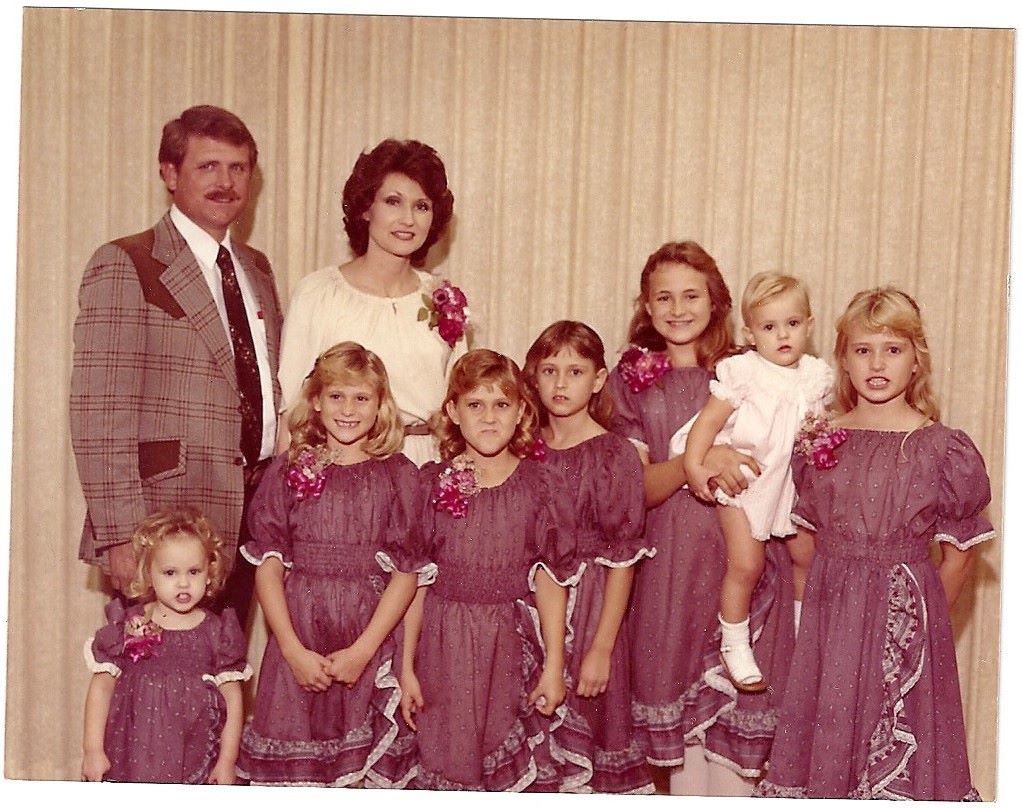
Dad continues, "At the wedding reception JoAnna sang, "Through All Eternity", beautifully. By the time the twins were born we were living in Blythe, CA with five girls under the age of five. What a joy! The doctor was not expecting JoAnna to have twins. The delivery was finally by c section. When the doctor took away the first baby, the nurse said, "Doctor, there is one more." JoAnna spent a lot of church time in the foyer with adventurous babies, all just as cute as they could be. I was busy with many church positions, Elders quorum instructor, 70's pres. and in the bishopric. JoAnna led the choir, played the piano in church organizations and has a beautiful singing voice. In fact, the local Catholic Church would often pay JoAnna to sing, "Ave Maria" at weddings and funerals. I developed 320 acres of Jojoba at Desert Center, CA for a company in Bakersfield. We moved back to Mesa, AZ where JoAnna grew up and where I grew up until 12 years old. I continued in the Jojoba occupation until finding a job in Tucson. The Garrett Company moved us and we lived in Tucson for 3 years. Tucson and the 6th ward had the friendliest people and we enjoyed some good times with so many of them, hiking the canyon, girls camp and Mt Lemon, sports, testimony meetings, missionary farewells and so many others. The Garrett Company moved us back to Mesa. I started working with another division of Garrett as a Production Systems Engineer. I am currently working in real estate, buying homes for investors at foreclosure." JoAnna recalls: "Growing up, the children loved his story telling ability; he certainly has a gift for making the stories up as he goes along, including the related drama. It has been difficult for both Craig and myself to raise, tend, teach and referee the children, not to mention the 1,000 clean ups per day. However, we love each one with all our hearts and we rejoice in their singing "Glory to God" in full chorus." Alton Craig and JoAnna together created a tribe....they just kept coming: RaeChelle, Jocelyn, Kristin, Jaynann, Jamiel, Sunni, Julianna, Steven. And so it is no surprise we can report that by 2011 Alton Craig has 19 grandchildren. Growing up, his children fondly remember him helping us make our school lunches with his fresh homemade bread. We also remember dad baking scones and his yummy bread sprinkled with powdered sugar and drizzled in honey. For a while there, he was even making his own homemade soap. He photographed us regularly in our Sunday dresses and obliging us as we made him the center of our childish play. When we sang as a family, Dad loved it so much; it was as though he transcended space and time. In 1991 Dad wrote some of his memories: "when the kids were really young, we lived in Blythe and one of our favorite things to do was go down to the swimming hole along the Colorado River. The five older girls would pile up in the old blue bomb (pick up truck) and I would let them ride in the back where they could stand up and feel the wind on their faces. They would sing and laugh all the way to our favorite swimming place. The water was cool in the hot summer months. When we arrived, they would usually find the best sand bar to play on. The sand was constantly changing from the movement of the water so they had fun exploring the new, but old swimming hole. They would always try and find the most shells especially the shells that were not open and had something living inside them. After a couple of hours or until they were tired from playing so hard, I'd take them all home again." It wasn't always easy, but together, dad and mom made sure we had our early morning scripture study, family prayer and on Monday nights they would gather us again for Family Home Evening.


We laughed, played, cried and best of all, we sang together. Life in the Curtis family wasn't always easy and sometimes it was messy. But we all gave it our best, including dad and we loved each other the best we could and still do. Family life was a dominate part of dad's life for many many years. 2/4/1990 Alton Craig's letter to his parents while on their mission: “RaeChelle is working full time for Lamson college as a financial aid officer. Jocelyn had a date at BYU, so things aren't so bad after all. Kristin is going on her first date soon and she is making very good grades. Jaynann and Jamiel are always bugging me about driving-they have lots of friends and are starting baseball practice now. Sunni and Julie love to dance-both are on the honor's roll. Also have lots of friends. Steven is all boy-he likes the dirt and makes the bang sounds and car sounds. I sure do love those kids. I love JoAnna and I love you. Craig” JoAnna remembers fondly, "When we were first married, Alton Craig displayed a creative sense of humor. I remember he kept me laughing on long trips from Utah to Arizona with funny stories. He also has a gift at resolving personal conflicts by thinking out of the box. When we would have a problem he generated win-win solutions for both of us. Another fond memory is when Jaynann and Jamiel were 9 months old with the chicken pox he bundled them up in the car seat and drove them around to sooth them. He said, "This is their first experience with pain and I want it to be a good one". A. Craig was always very supportive of his family and loved them very much." Alton Craig's sister, Carol, recalls: "The children came along and our girls too and they were happy playing with each other. Craig’s girls could sing. They could make any gathering of family or church function stand in amazement and admiration. These were the times he was very proud of his girls and often told us so.

He loved them a lot. JoAnna, his wife was the apple of his eye. She had many talents and he loved her very much. I could tell by the way he would look and talk about her. I know that he really loved his family. Our brother had very deep feelings of kindness and concern for our father and was there to help when asked. He checked on grandpa often. He made a great contribution in our family and it is my wish that he will have happiness and I am glad he was in our family. I am glad he had the opportunity to have a lovely wife and all of his girls and one last pride and joy a boy. He wanted one for a long time and he was blessed with one last joy." Inventions and Achievements Inventor, Entrepreneur, Dreamer that's our dad. Dad was always inventing things and "thinking outside the box” and always had plans for a new creation. His brother Mark relates: "He loved to be creative with his imagination as well as with his hands. In fact, he thought of an imaginative idea and then set about to try and make it a reality. He succeeded in many of these ventures." Some of these ventures include: “Plan Your Week Planner”,
(before they were sold in stores) “Water Walkers”, “Hulling Machine”, a water well system, vacuum hair cutter (before there was one on TV). He built homemade stilts for us children and he and his father, Samuel Fred Curtis partnered up to build the beautifully designed home he lived in the last 15 years of his life. He describes these ideas in a letter he wrote to his parents when he was in the Army July 1966: "I have been reading a book called "Applied Imagination" by Alex F. Osborn. It's used as a regular text at the University of Buffalo. It talks all about ideas and how to correctly think them up and apply them. It has been particularly interesting to me because in my secluded moments I am always entertaining one creative thought or another. This book has helped to organize my wild ideas and thoughts more and clarify them. I took notes on it , so I might refer to them later."
From The Oklahoma Journal, February 20, 1972: The brainchild of Craig Curtis and backed by Dr. Charles H. Farr, Water Skeeters are in amazingly simple answer to a feat that has astounded man for almost 2,000 years. They are plastic foam floats which attach to each foot. With minor adaptations, the foot floats easily can be converted into a floating fishing raft. During a demonstration, Craig Curtis, 15 inventor of Water Skeeters, walks back to shore after taking a stroll on lake Thunderbird. Curtis, 28, said the idea came to him in a "dream" while sick in bed during his college days two years ago. "I just saw this man walking on the water and told myself, 'I'm going to find a way to do that,'" Curtis explained." He was a dreamer...literally.

In the 1980's, dad invented the "Lewis-Curtis Hulling Machine".
It was his most successful invention. His idea was to take off the outer shell of the nuts on-site or in the field by taking off the outer shell and was an innovative, new concept in the production process. It featured two tone electrostatic powder coating and the finish was acid, impact, salt and humidity resistant. Had a 5 hp, 220 volt single phase motor and conveyor belts with de-twigger and de-stoner options. It also had an enclosed blower attachment for indoor processing.
In the late 1990's, dad started his own window washing business: "Sparkle Window Washing". For a while, dad always had his ladders and his window washing kit in the back of his truck where ever he went-always and ever ready for business. Not surprisingly, dad had adapted and refined his tools and the system of washing the windows; making his business operation very efficient. Dad was always thinking and working out ways to make life easier and well-just better. It seemed he had every kind and size of squeegee ever made in his tool collection. This model was made by Orek, but it is very similar to dad's original design. Dad called his the "VacUcut". We remember seeing dad's drawings and plans and I remember hearing him say not to tell anyone so no one would take his idea. It seems that is just what happened. Because as RaeChelle recalls: "dad saw an ad on television for a similar idea and he jumped up and said " hey, they stole my idea!" The machine pictured is the haircutting device dad used to cut his hair with regularly. Dad's idea of a Water Well System as told by his daughter, Kristin Curtis: "About a year ago (2010) dad told me of his idea to build a water well that pulls moisture out of the air. He planned to use the special copper sheets for funneling. He ran into design issues, such as the motor would have to be massive to run it, so he gave up building it. I never saw a drawing. He described it as being high up in the atmosphere and running down to the ground with a funnel shape at the top to collect water." General Contractor & Realtor Hard working, intelligent, practical - that's dad. In 1972, dad had his first adventure and experience with real estate and general contracting.

He moved a house onto a vacant lot and renovated it. Dad writes: "We bought this home for $500.00 moved it to 520 E. Avenue B., Blythe, CA, then lived in it for three years. I sold it for $20,500." Later in life, he earned and received his licenses both in General Contracting (1995) and Real Estate (2007).
Fred and Craig working on the house
December 1995 Alton Craig and his father, Samuel Fred Curtis, partnered up to build a beautiful home which was designed with energy efficient systems, innovative engineered R control panels and many other upgraded features. He finished and moved into his new home in the Spring of 1996 and lived there the last 15 years of his life. As it turned out, this home is the longest he lived in any one place.
604 S Silver, Apache Junction, AZ
It's no wonder he loved his cozy home so much. When he became ill, he wanted to stay and pass away there. However, it was only the last week of his life that he agreed to go to a care facility, but it wasn't without a little grumbling. In his back yard, this tree stump was one of dad's favorite spots to sit and watch the birds and animals. He always had his bird feeders filled so he could watch and enjoy their daily activities.


CRAIG’S LIFE TIMELINE:
-Born August 26, 1943- a Thursday. In Phoenix, AZ. The Curtis family lived in their beloved “Blue House”, in Mesa,AZ off NW corner of ValVista & Broadway on a hog farm.
 -Jan 3, 1947 Alton Craig contracted the measles
-Feb 1948 learned to ride a horse
-Sept 1948 1st day of school. Started out with many tears, but turned out ok at the end of the day.
 -March 25, 1949 had his tonsils out
 -1949 moved to N. Parcell house in Mesa
-July 1951 moved into block house on the Maricopa farm -352 acres 40 miles southwest of Mesa. -1955 Fred traded the Maricopa farm for 2 smaller farms in Blythe, CA (Curtis family lived in Blythe 34 years) 431 So. 7th St., Blythe, CA
-1955 Dad contracted hepatitis and was hospitalized for a short time.
-1961 Graduated from Palo Verde High School, Blythe, CA (very involved in farming operations, refurbished Model A car, yearbook staff, cheerleader)
 -1961-1962 BYU Freshman, Helaman Halls B-2107, Provo, UT INVENTION: Weekly Planner cards
-September 1962-September 1964 served an LDS Mission to Texas.
January 1963- June 1963 companions with his older brother, Sam.
-1964-1966 BYU, Heritage Halls. Dramatic Arts Major
-March 22, 1966- March 21, 1968 US ARMY. Ft. Bliss, Texas. Ft. Polk, Louisianan. VietNam. Ft. Hood, Texas.
-August 20, 1968 married to JoAnna K. Williams In Mesa, AZ Temple. No honeymoon, lived at 167 E. 200 North, Provo, UT. Attending BYU dramatic arts major.
-August 3, 1969 child born Salt Lake City, UT
-Sept 1970 moved to 33 East 300 North, Provo, UT.
-June 1971 moved to 1000 Cornwell Dr. #11 & later #148, Yukon, Oklahoma to be Regional sales representative for Spudnut donuts
-July 1971 INVENTION: “Water Walkers” or “Water Skeeters”
-September 19, 1971 child born Oklahoma City, OK
-March 1972 moved to 4022 N. Meridian #7, Oklahoma City, Oklahoma
-1972-1975 Moved to 520 E. Avenue B Blythe, CA. Dad moved this house onto a vacant lot and renovated it.
 -November 11, 1972 child born, Mesa, AZ
-March 13, 1974 two children born Mesa, AZ
-1975-1978 moved to E. Barnard Ave, Blythe, CA
-1978-1980 moved to old Sourdough Rd. Ehrenberg, AZ
 -May 3, 1979 child born Mesa, AZ
-May 20, 1980 child born Mesa, AZ
-1980-1982 lived at 350 N. Acacia, Blythe CA INVENTION: Hulling Machine
-1982-1984 lived at 1550 N. Stapley #132, Mesa, AZ Jojoba occupation
INVENTION: Vacuum hair cutting machine
-June 22, 1984 child born, Mesa, AZ . Finally the child dad always wanted.
-1984-1985 moved to 5636 N. Via Latigo, Tucson, AZ began working for Garrett Air research
-1985-1987 moved to 6342 N. Barcelona, #120, Tucson, AZ
-Summer 1987 transferred to Garret Air Research Phx division and new position as production systems engineer
-Fall 1987-July 1989 moved to 444 E. Tremaine, Gilbert, AZ – big brick house on a corner lot with a big yard and we even had a horse. We loved that house!
-July 1989-1993 moved to 1208 W. Sandhills Court, Gilbert, AZ, Alton Craig was involved in real estate buying homes for investors at foreclosure and hulling machine business.
-1992-1993 Jocelyn, RaeChelle, Jaynann and Jamiel were all married within 1 year of each other. Kristin, Sunni, Julianna and Steven remained at home.
-1994 moved alone to 331 N. 3500 E, Lewisville, IDAHO and in 1995 moved back to Mesa.
 -1995 ACHIEVMENT: Four Pillars Development and Construction business license also his General Contractor license, ENTREPENUER: started his window washing business “Sparkle Window Washing”
-1995-1996 ACHIEVMENT: built his home and lived there until the end of his life. This was the longest place he ever lived: 604 S. Silver, Apache Junction, AZ.
- 2003 Appendix taken out
-2007 AZ real estate license. Realtor -September 2010 saw his primary care physician (PCP) for a pain on the left side of his rib cage. The PCP said he bumped his side and the pain would go away in a week. The pain didn't go away-it got worse.
-November 2010 to ER and admitted to VA hospital for extreme pain in his side and chest area and with a CT scan showing a dark area and was admitted to hospital for biopsy. Biopsy confirmed adrenal and lung cancer as a result of exposure to agent orange in VietNam. He was already stage 4. Additionally, due to his exposure to wartime conditions, he also suffered from hearing loss, post traumatic stress disorder, night terrors and jungle rot.
We all suspected dad was haunted by what happened during his service in the Army and it caused him much pain emotionally and physically. His cousin Kelly Curtis writes: “He was, in fact put in a position on the lines, to do just what we all had hoped wouldn't happen, hand-to-hand battle experiencing things he never would talk about the rest of his life. Besides the fact that it was more than he could bare to recall this experience, it was of great importance to him to protect the hearts and minds of his loved ones by not ever telling of what he experienced Whatever he did was so contrary to his nature that it changed his path in, and of, life forever. Later, one could see it in his eyes, and in his countenance, he was a changed human being. So much so, that it would cause him to outwardly be someone he really was not, and for years distance himself from many of his hearts convictions and loved ones. It broke my heart and the hearts of those who had always been close to him and knew and loved another Alton Craig Curtis of previous years.”

-January 25, 2011 - a Tuesday at 4:00am He passed away peacefully in a hospice facility in Tempe, AZ. He was only 67 years old. One of dad’s last writings was to tell everyone the theme for his life and passing was “a Celebration of Success”.
 - January 29, 2011. It was a beautiful clear day, not a cloud in the brilliant blue sky. His family scattered his ashes at the base of the Superstition Mountains by plane. Dad wanted us to remember him each time we drove past the mountains enjoying the view, especially in the springtime when the wildflowers are in bloom. After all, he will have the biggest headstone for miles around.

A. Craig Curtis holding grandson Dallin Thomas, 2001. Gilbert, AZ

 It gives insight into what he wanted, how he felt and what he believed. September 21, 2007: "Today I begin a new life, I will greet this day with love in my heart, I will persist until I succeed, I am nature's greatest miracle, I will live this day as if it's my last, Today I will be master of my emotions, I will laugh at the world, Today I will multiply my value a hundred fold, I will act now, Divine Guidance." According to his wishes, his family scattered his ashes at the base of the majestic and awe inspiring Superstition Mountains by plane on Saturday, January 29, 2011. He chose the perfect place and way for the actor in him to play out his last and final dramatic scenes. The backdrop to this final act was special and familiar to us as our family would often hike these mountains together, becoming our unofficial family Mountain. So when he announced this would be the place, we all knew that was right and couldn't have been more perfect for dad. As we gathered together, mom said a few words that helped describe the scene that dad is now a part of forever: "The pureness of the elements, 21 peacefulness and beauty of the desert, the blueness and expanse of the sky, the ancient saguaros guard the gullies and washes, the feathered bird thrills out notes of expressive music and all nature co-mingles in harmony to celebrate the song of life." We know Alton Craig is resting high on our family mountain and that his legacy lives on. Pieces of him are prominent physically, mentally, emotionally and spiritually in each of his children and will continue in the generations to come. We celebrate his life of success as we look at ourselves in the mirror, love our families, create and reach for the stars every day. We can look to our family Mountain and let our hearts sing his song and know without a doubt he was a good and valiant man. Say not in grief 'he is no more', but live in thankfulness that he was and is with us always.
Steven C Curtis released dad's ashes by plane. Not a cloud in the sky. The white cloud you see are his ashes. The black dot to the left is the plane

MEMORIAL stone and TREE DEDICATED TO ALTON CRAIG CURTIS Lost Dutchman State Park, AZ January 28, 2012

Wednesday, March 27, 2013

Jezreel Shomaker

Jezreel Shomaker
The spelling of the Shomaker name has been spelled both with and without the first "e"; Shoemaker and Shomaker. When the publication source sites it with the first "e" I have left the quotation as is, but our family's line from Jezreel Shomaker is spelled without the first "e".

 THE SHOMAKER FAMILY OF KENTUCKY


This brief sketch offered by Roger Miller in 2000,
"Lakey Shomaker  (parents unknown, although related to Landers Shomaker of Buckingham Co. Va. and probably has connections in Prince Edward Co. Va.) married Sally Ellis (daughter of  Jezreel Ellis and Scytha Honey. Jezreel Ellis, is the son of John Ellis and Sarah Berry of Overwharton Parish, Stafford Co. Va.). Lakey Shomaker and Sally Ellis married in August 1795 in Bourbon County, KY, license in Paris, Ky courthouse records. Lakey and Sally settled first around Ruddell's Mills in Bourbon Co. and then near Butler in Pendleton Co., KY where they spent the rest of their lives. They had a large family of 13 or 14 children. Lakey Shomaker ran a ferry across the Licking River just upstream of present-day Butler. They migrated from Virginia.
Two of Lakey's sons, Jezreel Shomaker (md. Nancy Golden) and Alexander Morain Shomaker (md. Margaret Taylor) were living in Quincy, Illinois at the time of Mormon persecutions in the 1830's. Mormon refugees from Missouri were befriended by the citizens of Quincy, and shortly thereafter the two brothers joined the Mormon church, moved to Nauvoo, Illinois, and from there went west to Utah with the Mormon pioneers in 1847. Theirs was the last company to reach the Salt Lake Valley that first year, having been assigned to bring up the rear with a cannon and the bell from the abandoned Mormon temple in Nauvoo. Alexander Morain settled first near Salt Lake City, but later moved to Plain City, Utah, where he died.  Jezreel, one of the early settlers of Bountiful, Utah, went to Sanpete County Utah in 1849, where he helped to establish the town of Manti and became one of it's most prominent citizens".


In the publication "Pioneers of Pendleton County, Kentucky." we learn more of our Shomaker family,

"Lakey Shoemaker was born around 1775 in Virginia and died in September of 1824 in Pendleton County. It would appear that Lakey came to Kentucky from Virginia and he married Sarah Ellis on 13 Aug. 1795 in Bourbon County, Kentucky/Virginia. Sarah was born about 1775 in Virginia and died in Pendleton County in 1833. She was the daughter of Jezreel Ellis and Scytha Honey Ellis. By 1799, the family was living in Pendleton County in the Flour Creek Community. Lakey farmed on both sides of the Licking River, near Harris Creek. The Licking River was the main way for the settlers to get their crops to market. Since there were few bridges in those days, the only way to cross the river was by ferry. After Lakey returned from the War of 1812, in which he served under Captain Thomas Childers in the 4th Regiment of the Kentucky Militia, he was issued a permit to operate his own ferry in March of 1823."

Among Lakey's numerous children, the publication goes on to list an account of Lakey's first son, Jezreel Shomaker, born 29 Oct. 1796, Bourbon County, KY - died 30 May 1879, Manti, Sanpete, UT; married 1 April 1824, Pendleton County, KY to Nancy Golden, daughter of John Golden and Mary Robertson Golden, b. 22 April 1808 - d. 23 May 1870. Jezreel and Nancy moved to Adams Co., IL in 1828. He was one of the first to join Joseph Smith, the founder of the Mormon Church, in IL and was there when Smith was assassinated. Jezreel owned a 160 acre farm in IL. He was a man of wealth, but gave (or sold) it all away when he joined the Mormon Church in 1847. He and his brother, Alexander, and their families came across the Great Plains with others traveling with Captain Charles Rich's Company. They arrived in Salt Lake Valley on 2 Oct. 1847, where they settled at Sessions, a settlement near Bountiful. It wasn't until late fall of 1849, that Jezreel ventured on to Manti, where he died. There he served for two terms as Mayor and was a member of the first City Council, besides being a prominent farmer.

1829 Jezreel Shomaker in ADAMS COUNTY, ILLINOIS


"History of Adams County, ILLINOIS. Camp Point derived its name from a point of timber, now within the limits of the village, and known by the early settlers as "Indian Camp Point" being a landmark for the early pioneers, and used in a still earlier day by Indians as camping grounds. Daniel Smith and James Lasley, brother- in-laws, were the first settlers in the township. Smith settled on the south east quarter of section 29, and Lasley on the southwest quarter of section 28, in 1828. In the fall of 1829 Lasley sold his improvements to Jezreel Shomaker, who continued to reside there for several years.

The pleasant, progressive village of 1,200 people, known as Camp Point, northeast of the central part of the county on the Chicago, Burlington & Quincy Railroad, is at the headwaters of the south branch of Bear Creek, and its site and vicinity still bear proofs of the natural charms of the early times which made the neighborhood such a favorite camping ground for Indian and white alike. The point of timber which originally extended into the prairie has been virtually obliterated by cultivated farms and the expanded village, but, even from the landscape of today, it is not difficult to reconstruct the Indian Camp Point of the '20s and '30s. When a petition was circulated to secure a post office at Garrett's Mills, it was thought that the name mentioned was too long and the "Indian" was omitted."

Camp Point Township

Camp Point was originally known as Indian Camp Point. In 1848, when the Post Office was established, the name was shortened to Camp Point. The township was created in 1850. The village of Camp Point was platted in 1855.

Early Settlers in Camp Point Township:

Daniel Smith - 1828
James Lasley - 1828
Jezreel Shoemaker - 1829
Mr. Calley - 1830
Jonathan Brown - 1830
William Wilkes - 1831
Samuel McAnulty - 1832
William McAnulty - 1832
Lewis McFarland - 1832
James A. Wallace - 1835
Adam Rankin - 1835
Rezin Downing - 1835
Peter B. Garrett - 1835
Richard Seaton - 1835

Jezreel Shomaker joins the LDS church


While living in Adams county, Illinois about 20 miles from Quincy, Jezreel Shomaker and Nancy Golden,  heard the gospel of Jesus Christ and joined the LDS church. They went to Nauvoo came to Utah in 1847, crossing
the plains in Peregrine Sessions'
company. He lived in the "Old
Fort" over winter, and in the spring
of 1848 moved to Bountiful.

 Settling Bountiful, Utah


Bancroft's History of Utah (p. 305) says:
"In the autumn of 1847 one Thomas Grover arrived with his family on the bank of a stream twelve miles north of Salt Lake City, and now called Centerville Creek. His intention was to pasture stock for the winter; and for this purpose a spot was chosen where the stream spreading over the surface forms plats of meadow land, the soil being a black gravelly loam. Here Grover, joined by others in the spring, resolved to remain, though in the neighborhood were encamped several bands of Indians, and this notwithstanding that as yet there was no white settlement north of Salt Lake City.''
Bancroft does not give the source of his authority for this statement, which does not agree with that of Whitney, who says that on September 28, 1847, Peregrine Sessions founded the second settlement in Utah, where the Town of Bountiful now stands. This was known for some years as the "Sessions Settlement," the name Bountiful having been given to it by an act of the Legislature, approved on
February 27, 1855. Some of Mr. Sessions' descendants still reside in the county. The first ground was plowed in the spring of 1848 by Mr. Sessions and Jezreel Shoemaker.

Jezreel Shomaker


SETTLING MANTI UTAH


When the Utah pioneers had secured homes in Salt Lake Valley and were preparing to convert the desert into fruitful fields, a delegation of Ute Indians, under Chief Walker, appeared in Salt Lake City, June 14, 1849, and requested colonists for Sanpitch Valley, to teach the natives how to build homes and till the soil. An exploring party, consisting of Joseph Horn, W. W. Phelps, Ira Willes and D. B. Huntington, left in August, and with Walker as a guide, entered the beautiful Sanpitch Valley, crossing the divide from Salt Creek canyon, and reached the present site of Manti, August 20, 1849. They were royally entertained by the savages, and after a few days returned and reported everything favorable for founding a colony.
A company of about fifty families from Salt Lake City and Centerville was organized and started late in the fall for Sanpitch Valley. The commanders were Isaac Morley, Seth Taft and Charles Shumway, who represented the civil and ecclesiastical authorities and Nelson Higgins the militars'. Among the original pioneers were the following men, some being accompanied by their families: D. B. Huntington, Barnes Ward, John Lowry, Sr., Titus Billings, G. W. Bradley, Albert Petty, O. S. Cox, Albert Smith, Jezreel Shomaker, Cjrenus H. Taylor, Azariah Smith, Abram Washburn, John D.
Chase, Isaac Case, Sylvester Hulet, William Potter, Gardner Potter, James Brown, Joseph Allen, M. D. Hamilton, William Richey, Harrison Fugate, Sylvester Wilcox, Gad Yale, John Carter, Isaac Behunnin, William Mendenhall, Edwin Whiting, William Tubbs, John Hart, John Baker, John Elmer, John Butterfield, Amos Gustin, John Cable and AY. K. Smith.
The company cleared roads, built bridges and successfully passed through Salt Creek canyon without any great hardships, and moved to the south in quest of a suitable location. Some wanted to pitch camp at Shumway Springs, but better counsel prevailed, and the present site of Manti was selected as the frontier town of central and southern Utah. The first camp was made on City Creek on the evening of November 22, 184:9, and temporally houses made of wagon boxes, comprised the town.
In a few days the snow began falling and continued almost incessantly until the ground was covered to a depth of three feet or more, and the colony changed quarters to the south side of temple hill, where some families had dugouts, while others occupied their improvised wagons and tents.
That winter was most severe and the snow fell to a greater depth than ever was known to the Indians, and the equal has never since been recorded. Men and boys were engaged almost daily in shoveling snow  to bare the grass and furnish shelter and food for the starving cattle. Even the horns of cows and oxen were sharpened by filing, to give them better means of defense in fighting wild animals, and enable them to break through the crust of the frozen snow in search of the dry grass. Of the two hundred and forty head of cattle brought in by the colonists, only one hundred and thirteen were living the following June. The Indians camped around the colony greedily devoured the dead animals and praised their white neighbors for giving them the beef to ward off starvation.
When the camp was made and all was in readiness for the winter, a company of twelve, under the command of Jerome Bradley, was sent back to Salt Lake City after provisions. TheA' loaded their supplies and started for Manti, but were detained at Provo, on account of reported Indian hostilities. Two friendly Indians, Ammon and Tabinan, a brother of Chief Walker, volunteered their assistance as guides, and the party left Provo and continued on to the "Forks of Salt Creek," where they were forced to camp on account of the great depth of the snow. The next January, Tabinan rode into Manti and informed the people that a white man was lying across the Sanpitch river, almost dead. A party headed by Bishop George W. Bradley, started out on snowshoes and found one of the supply company, trying to wade through the snow, which was three or four feet deep. He reported the company snowed in, and sleds were drawn by hand over the snow, ranging in depth from 8 to 20 feet, to their camp and the supplies brought in during the month of March. Among the people arriving then was Daniel Henrie and wife, she riding on one of the sleds.
In the evening following the first warm day of early spring, the peaceful colonists were startled by a continuous hissing and rattling of myriads of rattlesnakes that made a simultaneous attack upon the habitations, wriggling and writhing about in the boxes, beds, cupboards and everywhere they could get inside the homes of the settlers. A general warfare was inaugurated by the aid of pine-knot torches, and many hundreds of the reptiles were killed, nearly five hundred being slaughtered in one
night. The strangest thing connected with the raid of these deadly serpents was that not one person was bitten, though the coiled enemies were everywhere present, in threatening attitudes, frightening men, women and children on every hand. Notwithstanding the severity of the winter and scarcity of food, on account of supply teams being snowed in at Salt Greek, the people enjoyed remarkably good health and but few cases of sickness occurred.

1850 census (see page 9 for Jezreel Shomaker family)
In the spring of 1850, When time for plowing and planting came there was but one team able to draw a plow through the native desert, until feed was obtained from the growing grass. This team belonged to Jezreel Shomaker, and was used to break small garden patches, while the other poor animals were resting and recruiting. The snow which had lain on the ground all winter to the depth of three feet or more was slow in melting and no crops were sown until June. But, the colonists were fortunate in having a fair supply of seed, and the soil proved very productive, thereby giving some green vegetables for food within a short time after planting. Small ditches were taken from the creek, and the water freely applied to the then parched sand.
The act of Congress organizing Utah Territory was approved September 9, 1850, and Brigham Young was appointed Governor, A provisional form of government was instituted and Isaac Morley and Charles Shumway represented Sanpete county in the first Legislative Assembly. That legislature met in Salt Lake City, and passed an act incorporating Manti City, which was approved February 5, 1851, at the same time Ogden and Provo were incorporated, they being the only cities in Utah, excepting Salt Lake City. During this season the city, comprising ten square miles, was surveyed by Jesse W. Fox, and the people left their camp under "Temple Hill" and moved to their city lots. Titus Billings and Jezreel Shomaker built the first houses, which were followed by others before winter. A city government was formed, and the colony began to give evidences of prosperity.
The Legislature recognized the value of a city organization for Manti, and on February 6, 1851, a bill was passed and approved by the Governor incorporating the city. The area then included ten miles, extending from Six-Mile Creek on the south to Willow Creek on the north, and from Sanpitch river on the west to the Wasatch mountains on the east. In April, 1851, the first city election was held and all "free white male inhabitants of the age of eighteen years" were permitted to vote. The officers elected were: Dan Jones, Mayor; Jezreel Shomaker, Phineas W. Cook, O. S. Cox and James
C. Brown, Aldermen; John D. Chase, Edwin Whiting, Abram Washburn, George P. Billings, Isaac Morley, Jr., S. H. Marble, Newman Brown, John Lowry, Jr., and Cyrenus H. Taylor, Councillors. The bill incorporating the city provided that after the second Monday in February, 1863, the city officials should consist of one Mayor, two Aldermen and three Councillors.

Jezreel Shomaker Civic Service

City and County Organized, etc. In the spring of 1851 President Brigham Young again visited the valley, and on April 30 a high council was organized; Father Morley was the first stake president and his assistants were Titus Billings and Edwin Whiting.
The people were now moving upon their "city lots" as fast as possible, and our little burg was transformed from the pupae state into a full fledged city, with Dan Jones, Mayor; Jezreel Shoemaker, Phineas W. Cook, Orville S. Cox and James P. Brown Aldermen; John D. Chase, Edwin Whiting, Abram Washburn, George P. Billings, Isaac Morley Jr., Sam H. Marble, Newman Brown, John Lowry Jr. and Cyrenus Taylor, councilors.
 In addition to serving on the first Manti City Council, Jezreel also served two terms as it's Mayor according to Andrew Jenson's, Encyclopedic History of the Church, p.472
"Following are the names of the mayors of the city of Manti since the city was incorporated in 1851; Dan Jones, 1851–1853; Jezreel Shomaker, 1853–1855; Albert Petty, 1855–1857; Edwin Whiting, 1857–1861; Jezreel Shomaker (2nd term), 1861–1865;"

THE MANTI, UTAH SHOMAKER HOUSE


the National Register of Historic Places nomination form
  

SHOMAKER, HON. JEZEEEL, deceased, son of Lakey and Sally Ellis, was born in Bourbon county, Kentucky, October 29, 1796. He was brought up as a frontiersman in Pendleton county, where he was engaged in lumbering and farming. April 1, 1824, he married Nancy, daughter of John and Mary Robertson Golden, born in Pendleton county, Kentucky, April 22, 1808. About 1828 they removed to Illinois and located in Adams county, near Quincy, where he homesteaded 160 acres of land and purchased other claims, having the largest farm in the county. When neighbors settled
around him he donated land for a school-house, which was erected. He became quite a prominent man in Adams county, giving quarters to all religious societies, yet claiming allegiance to none, until in the 40's, when he joined the Mormon Church. This required the selling or giving away of all he had, and in 1847 he fitted up teams and wagons and crossed the plains, arriving in Salt Lake City with the pioneers in Capt. Charles Rich's company. His wife rode in a carriage and drove a horse
team all the way. He first located in Salt Lake City, then removed to Sessions settlement, near Bountiful. In the fall of 1849 he joined the pioneers and came to Sanpete, locating in Manti, one of the first colonists. Here he remained until his death, which occurred May 30, 1879. He had good
teams and plenty of provisions when coming to Manti, and assisted many poor families in getting the necessaries of life. When the church wanted money the leaders called upon Father Shomaker and secured a portion of his savings. If the poor needed grain or clothing they never called on him without getting assistance. He prospered in the accumulation of land and property, and occupied many prominent positions in civil and ecclesiastical matters, serving as Mayor for two terms and being a member of the first City Council.
His children were:
Sally, wife of Harrison Fugate of Emery county;
Jerusha, widow of George P. Billings; 
Ezra, a prominent citizen of Manti;
Laura, widow of Joseph Tuttle;
Lakey, a well-known farmer and sheep Owner, of Manti,
 John G.,
Theophilus,
 Marion
Jeptha,


MANTI TROUBLE WITH THE NATIVE  INDIANS

also see picture of indians

Footprints in the Wilderness, THE RHOADES MINES AND TEMPLE GOLD , page 116 
Now that the Utes had a cause to war with the settlers, all they needed was the occasion.
According to Indian custom, a brave had the right to beat his squaw and in Springville, a Ute was exercising this privilege when a white settler interfered. Blows were exchanged and the Ute was consequently killed. Here, then, was the occasion.

Chief Walker was encamped at this time on Peteetneet Creek at the mouth of Payson Canyon with his band of warriors. Possibly there would have been no trouble when the word of the wife beater's death reached Walker's camp had not a few of his more impetuous braves stole away that night into Payson where they shot and killed a man named Alexander Keele. (Alexander Keele related to our line, a son of Richard Keele and brother to Dabney Uel Keele)

The death occurred on July 18, 1853 and Walker's brother, Aropene, was attributed with the killing. The next day Walker ordered his band into the mountains for he realized that the settlers would soon retaliate in turn. The same day some of the Indians fired upon the cattle guard at Pleasant Creek (now Mount Pleasant) and the next day a raid was perpetrated against the community of Manti.

On July 23 a full scale battle took place at Pleasant Creek wherein about six Indians were killed and the remainder put to the hills. The settlers of Pleasant Creek moved into the little fort at Spring City which had been attacked twice already by Walker's Indians and where, on August 2, it was attacked again. All of the horses and cattle were driven away in the raid. A witness to these attacks has stated:

Two of the herding ponies eluded the Indians and returned to the fort, thereby giving the settlers a means of communication with Manti, the only point from which relief could be expected. A messenger was dispatched immediately, and by riding across the valley, then south, succeeded in evading the vigilant Indian scouts patrolling the eastern trail. The express messenger reached Manti at three in the afternoon When the news was received, drums were sounded, cattle collected, and sentries posted at all the prominent points, while hasty preparations were made for sending relief to Spring City. Three wagons, with twelve yoke of oxen hitched to each, accompanied by teamsters and twelve mounted guards, left as quickly as possible, reaching Spring City ;It daylight the next morning. The colonists were taken to Manti, and given quarters in a fort that had been built that year.

Another account, this time by Jezreel Shoemaker, a guard at the gristmill near the mouth of Manti Canyon, tells of the preparations against Indian attack during the uprising.

"At night we lay in the brush, near the mill, and listened for any sound that might tell of the approach of Indians. We kept our guns loaded, and were ready at a given signal to protect the building, if need he. The Indians tried hard to darn the stream that feel the mill pond, but were unable to carry out their plans. For over a month the little (hill was never left without a heavy guard. After the grain had been ground into flour, we relinquished the guard, and the mill was burned in the winter.,"

Aropene and his followers had repeatedly made cattle raids against Payson and some of the other southern settlements, but no all out attack had yet been perpetrated. In Payson, it was feared that such ail attack might take place and so men from Payson, Spanish Fork, Springville and Provo joined to form a pursuit posse. From Salt Lake City came an additional 100 armed and mounted men. What came to be known in Utah history as the "Walker War" was about to commence.

It will not be necessary here to record in detail all of the incidents which occurred during this conflict as they have been covered extensively in other sources and except for detouring the journeys of Thomas Rhoades into the Uintah Mountains for gold during the summer of 1 1353 they have no direct bearing on our story, bill suffice it to say that through the summer and fall of 1853 and into the late spring of 1854, the Indian depredations steadily increased.


CHURCH SERVICE:

In addition to his civic service, Jezreel served on the Manti Stake high council according to the newspaper The Deseret News, page 72 reported the following:

"Pres. Brigham Young and company spent this day in Manti. In the morning the Presidency proceeded to organize a high council for Manti as follows: Artemus Millet, Gardiner Snow, Freeborn Demill, Jezreel Shoemaker, James P. Brown, John Lawson, Welcome Chapman, George Pectol and Elijah Everett, and John Carter were set apart as High Councilors by Elders Wilford Woodruff and Ezra T. Benson.  . . The congregation was then addressed by Elders John Young and Lorenzo D. Young. In the afternoon the Assembly was addressed by Elder Wilford Woodruff, Ezra T. Benson and Jedidiah M. Grant. The Indian chief Arapeene also said a few words which were interpreted by Dimick B. Huntington. In the evening both places were occupied by the Saints in  singing, prayer and dancing until about 10 o’clock when all retired to their homes, highly gratified with the manner in which the day had been spent. source: Journal History of the Church, 30 April 1851." 

Jezreel Shomaker's passing

sanpete history book
1879
May 30. Jezreel Shomaker, one of the Sanpete pioneers, died at his home in Manti.

Hugh Welch Williams

Hugh Welch Williams (1830-1881)
Hugh Welch Williams was born September 11, 1830 in Lichfield, Connecticut to his parents Edwin Williams and Jane Livingston. He was named after his mother's cousin, Hugh Peebles Welch.

At the trying age of fourteen, just when he would need a father's guiding hand and a mother's gentle encouragement, Hugh's father Edwin passed away and just two short years later, his mother, Jane followed him in death. When Hugh's parents, Edwin Williams (1795-1842) and Jane Livingston Williams (1797-1844) died, the family was broken up. The two older boys, Benjamin and Edwin were old enough to provide for themselves. Catherine, the oldest child of the family whom was lovingly called 'Dear Aunt Kate' secured the position of governess to the two Mansfield daughters, Ellie Burnham and Louisa Mather Mansfield (Kate never married); with whom she made her home for many years. Mary, the youngest daughter, a baby at the time, was adopted by Mrs. Thomas Mather. Mr and Mrs Welch (Helen) were by this time married and they too made their home in Lichfield, the rare old town with it's beautiful trees edging lovely streams and winding roadways. There they made a home for the four youngest boys- Livingston, Hugh and the twins Charles and Fredrick. Interesting how Hugh's name sake, Hugh Welch Williams, would be reared and guided until he was ready to leave home.

From this home about 1854 when Hugh was a young man of twenty-three years old, so went forth the two brothers, Hugh and Charles with one of the companies of the New England Emigrant Aid; Pilgrims to this new land on the western prairies. After the close of the Civil War, came Mr and Mrs Welch with their two young daughters, Jennie and Gertrude to add one more family to the citizenry of Lawrence.

Upon Hugh's arrival in Kansas, he made a land claim and homestead at Hickory Point and we next find Hugh making his home at bachelor's hall. Hugh considered his claim worth a thousand dollars. He had 12 acres of improved land on it. He told his brother Charles that he would sell it and go further back into the country and take up another and with the money go into Missouri and buy cattle.

As fate would have it, Hugh had made his home in the same neighborhood as the Gleason family. It was at evening school that Hugh and Annis White Gleason officially met. Annis Gleason is the daughter of Salem Gleason and Polly Houghton Gleason. At a Thanksgiving dinner they were both invited to at the home of James Gleason (Anni's big brother, they were close), on the mile drive Hugh and Annis grew intimate. Soon after this they were engaged to be married. The marriage day was October 24, 1858 at a point ten miles south of Lawrence, Kansas by Justice William P. Nettleton.

Then came the Civil War. Hugh W. Williams was enrolled in the service the 11th day of September 1861 at Lawrence, Kansas. By Lieut. Allen and mustered into service as a private in Co. B. 9th Regiment Kansas Cavalry Volunteers, on the 22nd of October at Ft. Leavenworth, Kansas by Lt. Hollister Nov 19 1861. He was appointed Sgt from Pvt Nov 20, 1861. Promoted First Sgt June 1, 1862. Promoted to second Lt May 17, 1863 and resigned April 9, 1864.

During his enlistment, Company B spent most of their time at Ft. Hallock which is now an abandoned fort in the northern part of Colorado. The company was ordered out to this post to guard the Overland Stage going through Utah and points west, from Indian attacks. The Sioux Indians begin very hostile at that time. In a letter home he describes a battle the Company and Indians engaged in.
In a letter dated July 9th, 1865 from Ft. Hallock we learn of Hugh's activities;

" Last night we went in pursuit of Indians and came onto them soon after daylight. I with Corp. Watson rode ahead of the Company in order to have a talk with them. Three rode down and shook hands with us and while we were talking, the seven of them opened fire on us and by the way the bullets flew for a few minutes, I thought you "stood a right smart chance" of being a widow, but the Company made its appearance over the hill and the dark skinned gentlemen fell back to their main position. After which I dismounted two platoons and attacked them. We fought them two hours. The Indians chose a splendid position in which to receive the attack. They stationed themselves on top of a hill with the woods in the rear and on both sides of them.
First we fought them at long shot and then, closed in on them and drove them back into the woods and had them in full retreat when very much to my disgust, we were ordered to withdraw.
Our loss was one man dead and four wounded. We killed 94 Indians. This morning we buried out dead man. He was Sergeant Waugh from Big Springs.
Your Aff. Husband,
Hugh"

For ten years Hugh and Annis lived in contentment, tilled their ample acres, raised their family, neighbored with their fellow farmers and forgot the cruel separation and turmoil of war.

During the years he was raising his family, Hugh wrote a letter to his sister, Kate in Middletown, Connecticut. Dated October 17, 1868,

"Dear Sister,
We now have a post office established at this place, hereafter please address Vinland Douglas Co. Kansas. Our house is only about 60 rods from Galveston R.R. and the prospects are that a village will be built up here.
We have not sold our house in Lawrence but I exchanged an interest for horses, wagon, lumber etc. to go on with this place. This is a school section for which I pay thirteen dollars per acre in ten annual installments with interest at 10%. That is a high price but this is a choice piece of land. The quarter section south of us was sold at $8.00 per acre. I had my choice at those prices. We have an excellent neighborhood and a good school, and I feel better contented than I have on any place before. The land is, of course, unimproved and I have no crop in this year.
You ask about the children. I am a poor hand at description. Charley has got to be a great boy, rather backward in his studies but has a mechanical turn of mind, is rather tall for his breadth and has a head as large as mine. Is getting to help me a good deal about my work; is a good boy and I can depend on him.
Mary is good sized girl for her age, quick in her motions and quick to learn. She always succeeds in her undertakings.
Frank, Helen says, looks and acts just as I did at his age, but I do not think there ever was this much mischief in me that there is in him.
Eddie is the strongest one of the lot and the most practical. Thinks there is nothing too great for him to perform. When we were in town, Annis was known as "that woman wit the pretty children" and it is said that Katie was the prettiest of all. She had blue eyes. All the rest are black.
Yes, our little darling Katie is an angel in heaven. She had an excellent disposition, never cried and was the most patient baby I ever saw. Through all her sickness she endured the most severe pain without complaint. It did seem hard to part with her. As Mary says, "There is love for all." We do not know how much we love our little ones until they are called away from us.
Although we have four left, this is a lonesome house. On every side there is something missing; that little joyful face is not there-gone forever. Edwin talks about her every day and wishes she had not died so that he could have his "Darling Katie" to play with. Every day they all go to her grave.
Annis joins me in love. The longer I live the more I can appreciate the kind sister you have always been to me. God bless you always.
Hugh"


Hugh and Annis would go on to have three more children, Fred, Alice (died in childhood) and Ellie Burnham.

Then came the year of the Calamities of 1874. First, they years was not six weeks old yet when Ellie was born. Next, it wasn't until warm weather that the other pests arrived. Just as the young corn was coming into the ear, the drumming of wings filled the air and clouds of grasshoppers darkening the sun in their flight, arrived in hordes to complete the devastation of Kansas.

And a second year the grasshoppers came to get what they had overlooked the year before. Our part of Kansas was laid waste and desolate. There was no feed for man nor beast. Then began the Higera, those who could, moved away. We stayed on-we had to. Our cattle and horses were all dead, we could not leave. Even we children had nothing bur cornbread and water to wash it down. Somehow we lived through it, but the country was so impoverished there was no work for any man, so father (Hugh) had to look far away to make provision for his family. His opportunity came in an offer to go out on the northwest and act as purchasing agent for Mason and Brother.

All would have been well, but in that same year, and old Sioux squaw must pick up gold nuggets out in the Dakota Hills and come raving into Deadwood (Dakota Territory) about the find, starting a stampede to Deadwood and vicinity to locate mines. Of course Father (Hugh), the work now giving out at Mason and Bros. could see nothing better to do than locate claims along with the others. If Mrs. Squaw had thrown that gold nugget back on the rock pile and returned to her hunting grounds, she would have saved Hugh Welch Williams many lonely years, heartache and ultimate disillusionment.

Hugh set our for the far west and the Black Hills from Cheyenne on June 15, 1876. He writes home,
"I find Denver very lively, every one very busy and seemingly has plenty of money. Mr Mason, in connection with a partner, has a large livery stable here. He has at Ft. Collins a flouring mill with a large amount of wheat. He has a train (ox train) hauling from Ft. Collins to this place on the road all of the time and he has sent quite a lot of flour to the Black Hills. Ox trains are leaving here every day for the hills and fabulous reports come in of the amount of gold taken out on Deadwood Creek."

In 1877, Hugh writes,
"I am now out of employment, as Mr. Mason cannot send more flour here; freights are so high he can not compete with other routes. I have an interest in one of the richest gold lodes in the Hills, but the title is in dispute. Courts will be organized now in 60 or 90 days and the thing will soon be settled. My interest is a small one but the quartz is very rich and if we gain the suit it will give me enough to clear the place and buy a team.You many know our lawsuit is of some magnitude as the lawyers fees at $12,000 if they gain the suit. Was the mine I have interest in without a lawsuit it would be worth half a million dollars, but the company I belong to are all poor men while we are in content with three powerful companies with an immense capitol. It is now tied up with injunctions and is not being worked.
About two weeks ago, two parties of men had a fight in the mine. A tunnel in which about twenty men were at work was blown up and one man was killed by a rifle shot. Our company had nothing to do with it. Seventeen men were arrested and are now in jail waiting trial.
Kiss the children for me. I wish I could do it myself and you too."

While waiting for his lawsuit to be settled, Hugh occupied himself with prospecting likely locations.

From Deadwood 1878
-"I have just arrived from camp to Deadwood. I am here to attend Court. Our case comes up in a few days, the case now looks very favorable to us. It will not be settled this term of court, perhaps not for years. There has been a terrible snow storm here, snow in Deadwood seven feet deep. I had moved the camp the day before it snowed and luckily found a vacant cabin to go into. It snowed four days with terrible wind, the cabin was open and there was not door, so that the wind filled the cabin with snow. We had but one animal in camp, a donkey. We took him into the cabin with us. We had to sit up all night but we had plenty of pitch pine and kept a good fire. After the storm, we were nearly out of provisions and the other three men started out for Deadwood, twenty-five miles in hopes of making it in two days. I could not go on account of my rheumatism so there were but two of us in camp, the donkey and myself. The sixth day one man came back carrying a little flour and bacon and I had a feast as I had been living on beans for four days. The snow has gone off very rapidly and I got to Deadwood yesterday."

Hugh writes home again 1879 Camp on the Box Elder,
"Have been snowbound now for two months and the weather has been very cold but I have been comfortable under the circumstances as we have a warm cabin and are never without a dear hanging at the door. There are four of us together, all agreeable intelligent men which makes it much pleasanter than if they were otherwise."

1880 Hugh writes,
"It has been a long time since I have heard from you, I have put all my money into the mine but it was not enough so that I am now hold up for the winter. The snows have set in and I suppose communication will soon be cut off. Give my love to all the children, your affectionate husband, Hugh"

Hugh struggled against so much adversity, Indians, inclement weather, loneliness, disease all while searching for his illusive gold. He died not having produced any income from his mining endeavors and died alone in the dreary Black Hills that had so betrayed his faith. He died at Galena, Dakota Territory September 18, 1881.

One of Hugh's and Annis daughters, Mary went to Galena a number of years after his passing with the intention of marking his last resting place with a soldiers monument, but even the location of his grave has been forgotten.

Hugh's daughter, Mary writes of this time, "Father became interested in mining at Deadwood and was never home after that. He died in Dakota, leaving mines from which he never realized any income. The older boys were old enough to work on the neighbors farms, which kept us from starving."

The Children of Hugh and Annis:
Charles Eli Williams
Mary Maria (Williams) Meek
Frank Gleason Williams
Edwin Stanton Williams
Catherine Livingston Williams (died young)
Frederick Livingston Williams
Alice Catherine Williams (died young)
Ellie Burnham (Williams) Gamber

Much of the information above was taken from the writings of Ella Burnham Williams Gamber the youngest daughter of Hugh Welch Williams and Annis White Gleason Williams.

His grave marker is in the Vinegar Hill Cemetery at Galena, South Dakota placed in fall of 2018.
The descendants have a debt of gratitude to pay to Mr Michael Laufman with the Galena Historical Society of Galena, South Dakota for spearheading the Hugh W Williams headstone project. He petitioned the Veterans Affairs and had a stone authorized for Hugh. He additionally oversaw it's installation. Thank you Mr Laufman! We so appreciate you.

Hugh Welch Williams, Sept 11, 1830-Sept 18, 1881
Vinegar Hill Cemetery, Galena, South Dakota
installed in the Fall of 2018
The Leavenworth Standard, 24 Sept 1881, Saturday, page 2

Wednesday, December 5, 2012

Salem Gleason


Salem Gleason (1789-1865) Photo courtesy The University of Kansas


Salem Gleason, son of Peter and Annis (Harrington) Gleason, was born August 1, 1789 in Pittstown New York, near Troy. He was raised a Friend, (Quaker).


Easton, New York Meeting House of the Society of Friends where
Peter, Annis and Salem Gleason attended their meetings.
Nineteen year old Salem served as a private in the war of 1812 for five years, in the 7th Regiment U.S. Infantry in Capt. McClellen's Co. He enlisted November 1, 1808 for 5 years and was honorably discharged October 31, 1813.

His discharge bears the description, "New Orleans Oct. 31, 1813. Be it known that Salem Gleason, a private in Captain McClellen's company of the seventh regiment of infantry, having faithfully served the term of five years, the term for which he engaged, is hereby discharged from the army of the United States, and to prevent any improper use which might be made of this discharge, here follows a description of the said Salem Gleason: He was aged 22 years, six feet two inches high and has blue eyes and fair hair and complexion and is by occupation a farmer." signed by C. Wollstoncraft and Capt. Artill T. Comp.
He marched from Westerly, New York to New Orleans.

Not much is known of his service, he was discharged the day before Jackson's great battle at New Orleans.
Salem was given a military land grant in Winneshiek County, Iowa. This was granted for soldiers of The War Of 1812. He is listed as Gleason, Salem; Regiment:  7th Regiment United States Infantry; Granted to:  Salem Gleason.

Polly Houghton Gleason (1794-1859)
     Salem Gleason married Polly Houghton, a baptist, November 17, 1817 and are found living at Elizabethtown, New York near Lake Champlain. This was a beautiful place for a honeymoon and to start a family.  Salem stood before a panel of the Society of Friends and was excommunicated from the  Friends church for his marriage to a Baptist and for serving in the war of 1812. He was still a Quaker at heart and Salem never surrendered the soft speech of thee's and thou's from the Friend's faith. He wore little gold hoop earrings with the Quaker's theory that if one had trouble with their eyes, piercing the ears would bring a cure.

By 1824, we find the Salem Gleason family at Saratoga Springs, New York later in 1826 Greenfield (Note- Greenfield has since become a part of Saratoga Springs), near by. At this time their family consisted of Salem, Polly and their six small children.  Salem and Polly with their family journeyed across N.Y. State to Warsaw then on to Hamburg near Buffalo, close to the shores of lake Erie. One could imagine they traveled by boat most of the way down the Hudson to Cohoes then on the Mohawk and Lake Oneida and if the Barge Canal was then built, barged down to Tonawanda and from there overland south to Hamburg. We can better understand why these Friends preferred making their homes in New York and Pennsylvania than in Massachusetts. In fact, it was obligatory as early as 1660 when Massachusetts passed a law making adherence to the Friends sect punishable by hanging. Later a more lenient law of Cart and Whip provided offenders be tied to the end of a cart and whipped through successive towns until out of the jurisdiction of the Massachusetts Colony. The towns along the Hudson, across the state line; Troy, Hudson, Pittstown, etc. settled largely by New England Friends. In Hamburg, New York in 1831 our own Annis was born, however Salem stayed only a short while. By 1894 we find the Salem Gleason family in Crawford Co., Pennsylvania.  They were in Pennsylvania land now and consequently found the roving bands of Indians friendly. These Indians belonged to the Lenni Lenapee Tribe, a peace loving people who were driven out of New York and the Five Nations council by the fierce Algonquins and fled for refuge to the forests of Pennsylvania where they lived at peace with the white man.

In the History of Spring Township, Conneautville and Springboro Pennsylvania as transcribed from the History of Crawford County, Pennsylvania published by Warner, Beers & Co. in 1885, we learn that Polly Gleason, a practicing Baptist, helped to organize the first Baptist church in Spring.
"Spring Borough is located three miles north of Conneautville on Conneaut Creek, in the western part of Spring Township."The first Baptist Church of Springboro was organized May 25, 1833 by Rev. O. L. Dunfee of North Shenango with the following members: Nathaniel Pond, Henry Wait, John Gillett, Lila Woodard, Silas Cooper, Hiram Sheldon, Mary Pond, Polly Wait, Tryphosia Conover, Sybil Woodard, Polly Gleason, Mary Cutler, Ruth Gillett, Jarusha Mann, and Sylvia Hammon."

1840 Pennsylvania, Crawford County, Spring Township Federal Census. (Salem Gleason is 8th from the bottom)
Lists: 1 male under 5 (Jasper), 1 male age 10-15 (James), 1 male age 15-20 (Eli), 1 male age 40-50 (Salem),
 1 female under 5 (Nancy), 1 female age 5-10 (Annis), 1 female age 40-50 (Polly)
  Ella Gamber describes, "Friend Salem finds himself at Spring township, fifteen miles from Meadville, in Crawford Co. Penn. The only settlement in a vast wilderness. He bought on the 20th day of February 1834, a piece of woodland from Harm Jan Huidekoper and his wife Rebecca. It belonged previously to the old Crawford homestead and had been cut over about 20 years previously. A hamlet developed nearby called Spring Corners and later, our Annis went to the young ladies academy at Conneautville, a few miles distant. Much work lay ahead for the busy hands of Salem and his family, a clearing for the modest log house and sufficient land for the grainfelds and sheep pastures and flax fields. Their kitchen bread bowls and plates were made form the curly maple and beech of the forests. They spun their own sheets of linen, their own blankets and woolen things, made their own candles, raised their sheep, cows and horses and made some of their  own dyes from chestnut, walnut and log wood, elder berries, dew berries and wild cherries grew in abundance, as well as crab apples. His harvests were bountiful, two more children, Jasper and the baby, Maria, were born and they all went to school in the little old log schoolhouse at Spring Corners. But after coming to Pennsylvania there was one ingenious invention to lighten the load. Up to the time Annis was born Grandfather Salem had never seen a match for the very good they were not invented. But by the time Uncle Jasper and Aunt Maria arrived on the scene Salem was able to lay aside the steel punk box, with the well worn grooves in the sides for the matches that we now have, or probably the old Chinese block matches such as we used in California when I was a girl, 1874-1890) Ruth Field has the little steel punk box that once belonged to Grandfather Gleason. I had never before seen one. I told her that was what grandfather used to keep the kettle boiling when Annis arrived, but by the time her grandmother was expected, Grandfather just quickly struck a match in preparation of the "Blessed Event". I bet it was quite a comfort, at that. The Pennsylvania lands were fertile and in 1850 Salem was able to build a large comfortable 10 room log house which took the place of the log cabin. It stands today, (1900) almost as good as new, after doing service for 50 years. Salem and Polly experienced the reward of industry and lived and prospered on this homestead for twenty five fruitful years.  Up to the building of the big white farmhouse, Salem was Captain of his own soul, but soon political controversies arose, which together with his grown up family, changed his plan of living for him."
 In 1854 all was at peace in Pennsylvania, but in the halls of Congress the controversial Nebraska-Kansas bill was being debated and the question could be settled only by vote of the people living in Kansas. To gain more votes toward making Kansas a free state, the New England Emigrant Aid Company was formed to help relocate New Englanders out west to Kansas for the cause.
Two companies had already gone out from New England when G.W. Brown (son-in-law of Salem and husband of Lois H. Gleason) decided to organize a company from Pennsylvania. Our peace loving Quaker family decided to add their votes to make Kansas a Free State. Salem Gleason, veteran warrior of 1812, found himself in his old age involved in the border skirmishes between Kansas and Missouri preceding the Civil War.
 This company of G.W. Brown consisted of about 300 persons, including G.W. Brown's parents David and Abigail (Houghton) Brown (Abigail is Polly's sister) and four of the Salem Gleason family (James, Lois, Annis and Salome). Of the journey to Kansas we read in James Gleason's diary, "We made the first part of our journey in a crowded canal boat. At Sharon, took packet for New Brighton on the Ohio River; at New Brighton (still in Pennsylvania) the river was so low we went by rail via Cleveland and Chicago to St. Louis." After two days at St. Louis  the company went aboard the "Sanora" for the trip up the Missouri River and after a little over four days on the river they arrived at West Port Landing (Kansas City). Here they broke up the other members of the family took ox teams or ponies for Lawrence, but James having but 50 cents in his pocket and a farm in Pennsylvania which he could not sell, started out to walk. He describes, "I witnessed a snowstorm on the prairie and traveling through it was no boys play. I stayed that night at a tavern kept by a Shawnee Chief by the name of  Blue Jacket. The tavern consisted of two rooms, one for the women and one for the men. It had a dirt floor and grass roof and I lay down on the dirt floor to sleep with a blanket and buffalo robe for a bed."
This new company laid down their burdens at Lawrence, feeling they had reached the land of promise. The town they beheld could not have been very inspiring.  A few grass and sod houses, perhaps a few shakes.  There were no stores, markets and being in prairie land, there were very few trees. The first frame house was built by G.W. Brown to house the "Herald of Freedom" presses (newspaper) as well as his family. Our Annis lived there for a season, as well as James Gleason, who helped with the carpentry work for the home.
Salem and Polly Gleason would arrive in Kansas the following spring of 1855 along with their two youngest children, Jasper and Maria. They did not come with the first company as their farm had not yet sold. April 23, 1855, at the age of 67, Salem came to join his other children and this new country and cause. He left a comfortable home and largely improved farm with land in Pennsylvania.
Salem's daughter, Maria,  relates, "We lived on the hill just west of where the University now stands until the latter part of August then moved into the country to a place called Mud Springs near the claims. We found an abandoned cabin of logs on the Old Santa Fe Trail which afforded us shelter until father could get a house built on the claim. Here we were obliged to remain all winter as there are many hindrances to building even a log house in a new country. This house had been built and occupied a few years previously by a man named Beach from Ohio. Both he and his wife had died very suddenly just before we moved there. They had left a family of several children, on little girl, apparently four or five years old named Eliza Jane Beach, lived with the family of Coleman until the murder of Dow afterward she was sent to our house "for a few days" and remained for several years. The cabin was roughly built, the doors and roof made of shakes and of windows there were none. The inter of 1855-1856 was intensely cold. The fierce wind blew the snow through the cracks and chinks until in the morning we would wake to find two or three inches of snow covering us. Living neighbors to us at Hickory Point were Charles Dow and Mr. Bronson, also proving up on homesteads. In the neighborhood, on the Santa Fe Trail stood a place called the Santa Fe Wagon Shop owned by Mr. Poole. Here one day came father (Salem Gleason) to get some repair work done on a farming implement. Young Charley Dow who was a Free state man was in the shop at the time, when in came another neighbor, Mr. Coleman, a pro-slavery man. Coleman entered armed and began a dispute with young Dow. Father, seeing the dispute was growing serious, left the shop and returned home. In a short time a teamster passing reported that there was a man lying in the road. Father guessed at once that it was Dow but dared not go out to it until sufficient force had been gathered for defence in case of armed resistance. I was sent to noticy the neighbors and toward midnight a sufficient force of men had gathered to go after Dow's body. They took it down to Branson's house for burial. None of the men dared go on the road to Lawrence for lumber for fear of an attack, so my brother, James Gleason took lumber from his own supply for which he intended to build a house and made for Dow a coffin. My white dress served to make a shroud for him."
After this trouble, Salem was called before a panel to testify as to the events of the murder, as found in the book, "Report of the special committee appointed to investigate the troubles in Kansas" we learn in Salem's own words the events of the Dow murder,
"Salem Gleason called and sworn. I was present at the blacksmith shop, near Mr. McKinney's, on the Ulst day of November, 1855. I drove up to the blacksmith's shop some time between 12 and 1 o'clock. I heard hard words, and heard the blacksmith, a Mr. Poole, say he would not have such words in his shop, and they must go out of doors. I heard him say, "Mr. Buckley, if you cannot behave yourself, go out of the shop. I will not have such words in the shop." I then went into the shop. I saw Mr. Buckley and Mr. Dow there. The blacksmith was mending a small wagon skane for Mr. Dow. The conversation lowered as soon as I stepped into the shop. They soon had the wagon skane and lynch- pin fixed. Mr. Dow paid for his work, and left in the direction of his house. Then there was something said between the blacksmith and Mr. Buckley. And the blacksmith, Mr. Poole, said, " Why did you not shoot him then ?" Said Buckley, " I hated to shoot a man on hearsay ; but if he has said it, I'll be damned if I won't shoot him yet Buckley's gun was then cocked at both barrels ; it was a double-barrelled shot-gun. He said he cocked it to shoot him. He then left the shop, and started on his horse in the direction after Dow. When he took up the gun, which was sitting near the door, it was still cocked. I left the shop very shortly after Mr. Buckley did. He went east and I went west from the shop. Buckley took his gun with him. Some three or four hours after this there came along a teamster who lives at or near Council City, named Henry Smith. He informed my son that a dead man lay in the road east of the blacksmith's shop a little ; he did not say how far. I started for my horse, which was some eight or ten rods from where I was. I mounted him, and rode up to the place where the body lay, some mile or so from where I started. I saw the murdered man, who was Dow, lying with his head in the wagon-track and his feet on the side of the road, with the skane and lynch-pin still in his hand. When I came in sight of the corpse, there were some eight or ten men standing over him. As soon as I got, as I supposed, so as to be seen by them, they left. In this company I recognised Mr. Poole, Mr. Coleman, Mr. Buckley, and Mr. Hargous. The company, all except one or two, had guns, mostly double-barrelled shot-guns. There seemed to be a couple of youngsters in the company who were not armed. Mr. Poole came directly towards me as I was going up. I observed, " Buckley has shot Dow at last." " No,' said Mr. Poole,  It was not Buckley, it was Coleman".  I did not get off my horse when I reached the corpse, but I saw the blood running from his neck, his mouth, and nose ; and saw the blood on his breast. I merely stopped to look at him a moment, and then rode past him and went to Mr. Branson's, where Dow made his home. I informed them there that Dow was shot. Mr. Branson was a good deal alarmed at the news, and said he wished me to go on and give information. I rode from there to a Mr. Hopkins' to inform them. But my daughter had got there before me and informed them. My health would not permit me to ride any more, and I returned home. I noticed two shot-holes in Dow's neck as I was looking at him. I was not at the meeting called at the spot where Dow was found. Mr. Poole left the neighborhood about that time, and, I think, is now in the State of Missouri. Coleman has been backward and forward since that time, during this spring, to Washington creek, which is about six or eight miles from where I live ; generally with a pretty strong guard of from six to eight men with him. We knew nothing of where he was for some time after the murder of Dow. Dow was buried on the Saturday afterwards. At the grave, just after it was filled up, a motion was made by a man named Farley to burn the house of Coleman, who had left his house, with his family. I told them, saying, " Here is this man murdered, and for us to go to doing such a thing as that, it will operate against us. It will be better to fetch the offender to justice than to destroy property. The persons there fell in with me, and argued not to do it. Dow was not armed when he left the blacksmith's shop ; and I know he owned no small arms. He had there nothing in his hand but the wagon skane, which is a piece of iron about 12 or 15 inches long, between a quarter and a half-inch wide, and perhaps a quarter of an inch thick, and is used to go over the end of the axle-tree where the wheel goes on; and the lynch-pin is passed through it. Dow was considered a peaceable citizen. Dow made his home at Branson' s, but I think there was no relationship between them. Their claims adjoined. I am myself a native of New York, but emigrated from Pennsylvania to the Territory. Poole left his shop and the neighborhood shortly after the forces began to gather on the Wakarusa. I believe the Mr. Farley I have mentioned came from the State of Missouri. Coleman's house was burned some few days after Dow was buried. Farley was still in the neighborhood when the house was burned, but left shortly afterwards.
SALEM GLEASON
 Lawrence, Kansas Territory, May 3, 1856".

Proslavery men had flocked over the border from Missouri at the spring elections in Lawrence and voted without having established citizenship, returning to Missouri the next morning. They had elected Jones Sheriff of Douglas County. Sheriff Jones had old Mr. Branson arrested, but a group of Free state men including Salem Gleason and his sons James and Jasper gathered at Blanton Bridge and rescued Branson from the Sheriff.


Circumstances and events continued to be difficut for Salem on the evening of July 20, 1856 Salem was the victim of horse theft when his two bay horses were stolen. We read from the "The Miscellaneous Documents Printed by order of the House of Representatives"" regarding Salem's claim on page 221. Apparently, he was not compensated for his loss as it was deemed a consequence of the difficulties of the time.

Salem had proved himself and was appointed as a judge to help conduct the eections. List of Judges Appointed by Ex. Committee to Conduct the Election for the 1st District, Palmyra Precinct on Tuesday Oct. 9th 1855.

Headstone of Salem Gleason Oak Hill Cemetery,
 Lawrence, KS
The widowed Salem passed away September 10, 1865 at the home of his daughter, Maria Gleason Hubbell in Paola, Kansas. His wife proceeded him in death by six years. He was buried at High Prairie, Kansas and was afterward disinterred and buried in the family burial plot at Oak Hill Cemetery in Lawrence, Kansas. His wife, Polly Houghton Gleason, rests beside him. An ancient granite monument between the graves serves to record their burial place.

Obituary of his wife: GLEASON, MRS. POLLY H., wife of Salem, formerly of Pennsylvania, aged 68 yrs., 4 mos., died in Willow Springs Township, Sept. 1, 1859. (Lawrence, Herald of Freedom, Sept. 3.)

Obituary of Salem Gleason from the Miami Co. Kansas newspaper,"Argus"
"Paola, September 10, 1865, Died in this city, Salem Gleason, in the 77th year of his age. Like the aged Patriarch who watched upon the hills for the coming hosts, he too has been laid away in the silent city of the dead. At the age uncommon for this section of the country, he lived to see his adopted state o the outward road to progress and like the trees of our forest, fell when the bloom of age had become sore."

The Daughters of 1812 laid a marker for Salem Gleason in the Oak Hill Cemetery alongside his grave according to the newspaper article in the Lawrence Journal.

Salem kept the Gleason Family Bible which was known last to be in the possession of Hattie Gleason Whitmore (daughter of Jasper Gleason and Ann Crane Gleason, granddaughter of Salem and Polly Gleason) in the mid 1930's.


The Jeffersonian Gazette, 16 Aug 1900, Thu,  Page 1


The nine children of Salem Gleason and Polly Houghton Gleason are:
1. Salome Gleason b. July 31, 1818in Elizabethtown, New York and died 2 Oct 1873 in Lichfield, Taylor County, Iowa.
Married Seth W. Robinson to Saloma Gleason 17 Sept. 1840, Crawford Co. State of Pennsylvania married by  Ebenezer R. Hall of Spring Township. Salome and Seth had 3 children, Salem, Polly and Charity.
Lois Houghton Gleason Brown Walker
 (1820-1894)
2. Lois Houghton Gleason b. 20 Feb 1820 Elizabethtown, New York, d. 1 Mar 1894 Douglas County, Kansas is buried in the Oak Hill Cemetery, Lawrence, Kansas. (the infant son of Ella Hubbell and Millard Field is interred above her in the same grave). Lois married her first cousin, George Washington Brown known as G.W. Brown on January 8, 1840 in Conneautville, Pennsylvania. G.W. Brown was the Editor of the Conneautville Courier and Lois had gotten herself disinherited for her marriage to her cousin by her Quaker father for her "irregularity", but still stuck to her guns and wore down the opposition. She married second, Henry H. Dorsey previous to Feb 11, 1863 and married lastly, James F. Walker in Lawrence, Kansas.
3. Mary Gleason b. 4 Jan 1822, d. 1 Oct 1824 born and died in Elizabethtown, New York.
4. Eli Gleason b. 15 Jul 1824 Elizabethtown, New York, d. 1 Nov 1846 Conneautville, Pennsylvania
Married Sarah Ann Nelson  December 31, 1845 in Conneautville, Pennsylvania. Sadly, less than a year after his marriage, Eli died from drowning.
brother and sister James Houghton Gleason and
 Annis White Gleason Williams abt 1856
5. James Houghton Gleason b. 10 Nov 1826 in Greenfield, New York, d. 9 Jun 1901in  Pleasant Grove, Kansas. He is buried in the Oak Hill Cemetery.
"Obituary of JAMES H. GLEASON, farmer, Section 13, P. O. Pleasant Grove, came to Kansas in 1854; settled in Lawrence, and the following year moved to Willow Springs Township, where he still resides on his farm, containing 160 acres, which he has improved. When he commenced on this place, he had no near neighbors, but now every farm adjoining him is well-improved. His stock of horses, cattle and hogs shows him to be a good farmer, and his house and barns are among the best in the town. Mr. Gleason was born in Saratoga Springs, N. Y., November 10, 1826, but when a child his parents moved to Hamburg, Erie Co., N. Y., where he remained for several years, and then moved to Crawford County, Penn., and there resided until he came to the State. He was burned out by Quantrill, 1863; house, barns and timber in yard all destroyed. Mr. G. was united in marriage in Lawrence, Kan., July 7, 1863, to Miss Joanna L. Ayer, daughter of Charles Ayer, Esq. They have three children - Charles J., Clifton A. and Alice J Bowman. Mr. G. and family are members of the Methodist Church."
6. Salem Gleason Jr. b. 23 Apr 1829 at Warsaw New York at the Western part of the state near Lake Erie, d. 20 Feb 1830
7. Annis White Gleason b. 14 Jan 1831 in Hamburg, New York near Lake Erie, d. 24 Oct 1895 at Table Rock, Colorado. Annis was named after her father's sister Annis (Gleason) White. Annis married Hugh Welch Williams October 24, 1858 of Douglas, Kansas. They had eight children, Charles Eli, Mary Maria, Frank, Edwin, Catherine, Fredrick, Alice and Ella.
8. Jasper Gleason b. 24 Aug 1835 at Springtown near Conneautville, Pennsylvania, d. 7 Aug 1902, Ashland, Oregon, USA. Jasper married Ann Crane and had 5 children, Polly, Lois, Annie, Hattie (Hattie is the last known person to have the Gleason Family Bible from Salem Gleason) and Ellen.
9. Nancy Maria Gleason b. 20 Feb 1838 at Spring, Pennsylvania, d. 17 Apr 1906 in Toledo, Ohio buried in the Oak Hill Cemetery, Lawrence Kansas. She married Willard Orvis Hubbell April 16, 1860 in Lawrence, Kansas. This is the daughter with whom Salem Gleason lived and passed away in her home. Their children; Ella, Bessie, Frank, Henry Salem (noted painter), Charles and Willard.

MISCELLANEOUS:

"Another thought - There is a great deal of Gleason family information - military, location, etc. at the Old Castle Museum, Baker University, Baldwin City, Kansas. The Gleason farm was in Prairie City (west of Baldwin a mile or so). If you could contact the curator you may have better luck. They had a full wall display of the family tree, photos and files of info on the individuals, including war stories. Basic time period is 1850-1868 or more."

My connection to Salem Gleason
Salem Gleason married Polly Houghton who had Annis White Gleason
Annis White Gleason married Hugh Welch Williams who had Charles Eli Williams
Charles Eli Williams married Louisa Christensen who had Charles Fredrick Williams
Charles Fredrick Williams married Illa L. C. Hawks who had Carroll D. Williams
Carroll D. Williams married Lois Keele who had LIVING Williams
LIVING Williams married A. C. Curtis and then came.....